WPC fencing is generally more stable and weather-resistant than traditional wood fencing in hot climates. However, under long-term strong sunlight and high temperatures, improper materials, installation, or structural design can still lead to expansion, fading, or deformation.
This is especially important in regions such as:
- The Middle East
- Australia
- Southern United States
- Southeast Asia
- Coastal areas with strong sun exposure
Below are the most important things to consider when using WPC fencing in extremely hot weather.
1. Thermal Expansion and Contraction
WPC fencing is made from a combination of wood fiber and plastic materials such as PE or PVC.
Under strong sunlight, the surface temperature of the fence may reach:
- 60°C–80°C in summer
- Even higher for dark-colored products
As temperatures change, WPC fencing may experience:
- Slight length expansion or contraction
- Board swelling
- Changes in joint spacing
This is one of the most common characteristics of WPC materials.
Generally:
- Longer fence sections
- Larger temperature differences
- Darker colors
will result in more noticeable thermal movement.
2. Leave Expansion Gaps During Installation
Many fencing problems such as bending, bulging, or cracking are caused by overly tight installation rather than the material itself.
If no expansion space is left, strong heat may cause:
- Boards to warp
- Clips to deform under pressure
- Posts to become stressed
- Fence panels to bulge
Recommended Installation Practice
It is recommended to:
- Leave expansion gaps at both ends
- Keep proper spacing between boards
- Avoid completely locking boards too tightly
This becomes even more important for fence spans over:
- 1.8m
- 2m
- 3m
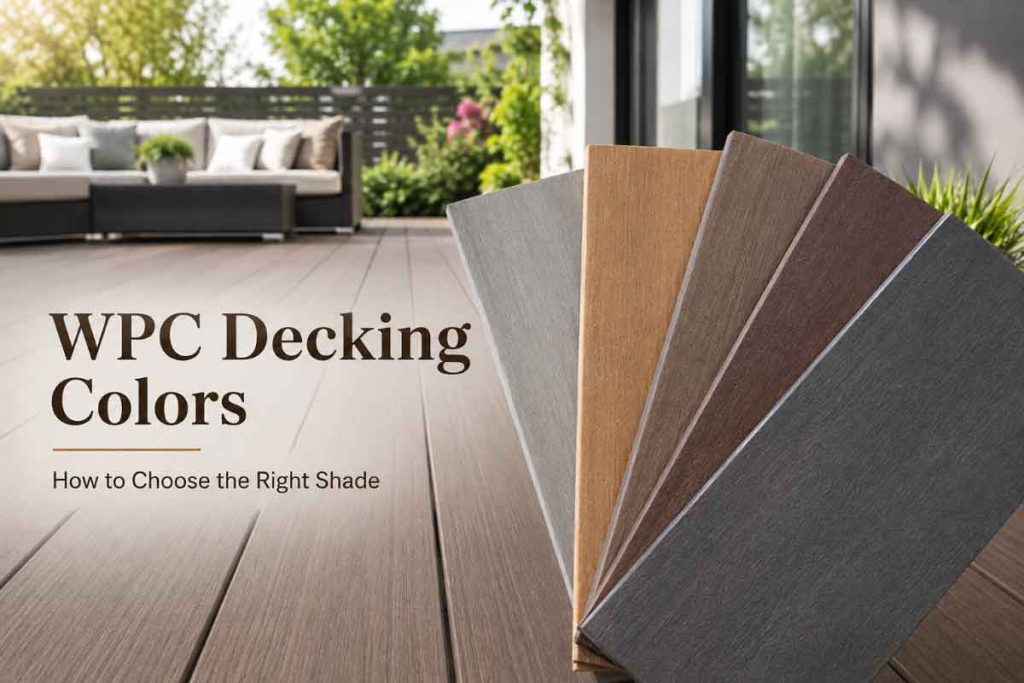
3. Dark Colors Absorb More Heat
Fence color has a major impact on surface temperature.
Colors such as:
- Black
- Dark Grey
- Walnut
usually become much hotter than:
- Light Grey
- Teak
- Sand
- Light Brown
because darker colors absorb more solar heat.
This may lead to:
- Higher surface temperatures
- Greater thermal expansion
- Faster aging over time
In extremely hot regions, many projects prefer:
- Lighter colors
- Co-extrusion UV-resistant products
to reduce heat buildup.
4. UV Resistance Is Extremely Important
In hot climates, UV exposure is often a bigger issue than heat itself.
Low-quality WPC fencing may develop:
- Fading
- Whitening
- Surface chalking
- Brittleness
after years of direct sun exposure.
Common causes include:
- Insufficient UV additives
- Excessive recycled material
- Thin co-extrusion protective layers
High temperature combined with UV radiation can significantly accelerate material aging.
For hot-weather applications, co-extrusion WPC fencing is usually recommended for better durability.
5. Proper Airflow Helps Reduce Heat Buildup
If fencing is:
- Completely sealed
- Installed directly against walls
- Built without ventilation gaps
heat can become trapped inside the structure.
Over time, this may cause:
- Local deformation
- Increased internal stress
- Reduced service life
Using:
- Ventilated designs
- Slatted fence structures
- Proper spacing
can improve stability in high-temperature environments.
6. Metal Reinforcement Can Improve Stability
In extremely hot regions, many large projects use:
- Aluminum posts
- Aluminum-core WPC
- Steel internal reinforcement
because pure WPC is generally less rigid than metal under long-term high temperatures.
Metal reinforcement helps improve:
- Structural stability
- Deformation resistance
- Wind resistance
especially for:
- Commercial projects
- Coastal applications
- Large-span fencing systems
However, aluminum conducts heat quickly, so its main advantage is structural strength rather than cooling.
7. Co-Extrusion Products Perform Better in Hot Climates
Different surface technologies perform differently under strong sunlight.
Generally:
- Co-extrusion WPC offers better weather resistance
- 3D embossed surfaces provide stronger aging resistance
- Standard embossed products are less durable
Co-extrusion layers help improve:
- UV resistance
- Water resistance
- Stain resistance
making them more suitable for long-term outdoor exposure.
How to Reduce Heat Buildup on WPC Fencing
In most cases, active cooling is unnecessary. Instead, good design and material choices help reduce heat absorption naturally.
Choose Light Colors
This is one of the most effective solutions.
Light-colored fencing can remain 10°C–20°C cooler than dark-colored fencing under direct sunlight.
Avoid Large Dark-Colored West-Facing Areas
West-facing fences receive the strongest afternoon sunlight.
Dark-colored fencing in these areas can become extremely hot during summer.
Many projects reduce heat buildup by using:
- Mixed color designs
- Shade structures
- Green plants or landscaping
- Slatted fence designs
Add Shade Structures
Features such as:
- Pergolas
- Trees
- Shade sails
- Climbing plants
can effectively reduce direct sun exposure.
These solutions are especially common in commercial and landscape projects.
Avoid Frequent Cold Water Cooling
Occasional washing is fine.
However, repeatedly spraying cold water onto extremely hot fencing may increase thermal stress over time, especially for lower-quality products.
Conclusion
The biggest challenge for WPC fencing in extremely hot climates is not simply the heat itself, but:
Heat + UV exposure + improper installation
By following these recommendations:
- Leave expansion gaps
- Use UV-resistant materials
- Choose co-extrusion products
- Avoid oversized unsupported spans
- Maintain airflow
- Prefer lighter colors
WPC fencing can remain stable, durable, and attractive even in long-term high-temperature outdoor environments.