Outdoor dining areas have different flooring requirements from ordinary residential decks.
Restaurant decking may be exposed to hundreds of footsteps, moving chairs, spilled drinks, cooking oil, food residue, rainwater and frequent cleaning. In BBQ restaurants, rooftop dining spaces and outdoor cafés, the surface may also face grease, strong sunlight and changing weather.
For these reasons, restaurant owners, contractors and project buyers should not choose decking only by appearance.
WPC decking for restaurants can be a practical option because composite boards combine outdoor durability with relatively low routine maintenance. Multiple surface textures, colors, hollow and solid profiles, as well as capped and traditional WPC options, are available for different commercial applications.
However, not every WPC board is automatically suitable for every restaurant.
Buyers should evaluate:
- Expected foot traffic
- Surface texture
- Wet conditions
- Food and oil stains
- Cleaning frequency
- Furniture movement
- Sun exposure
- Drainage
- Substructure
- Replacement requirements
The most suitable product depends on how and where the restaurant deck will actually be used.
Why Restaurant Outdoor Areas Need Different Decking
A residential garden deck and a restaurant terrace may look similar, but their operating conditions can be very different.
A commercial dining area may experience:
- Continuous customer traffic
- Waiters walking repeatedly along the same routes
- Tables and chairs moving every day
- Food and beverage spills
- Oil and grease contamination
- Regular washing
- Outdoor rain and humidity
- Long daily operating hours
These conditions can increase surface wear and cleaning requirements.
Therefore, restaurant decking should be evaluated as a commercial flooring system rather than simply a decorative outdoor surface.
Is WPC Decking Suitable for Restaurants?
WPC decking can be suitable for many restaurant outdoor areas when the product specification matches the project.
Potential advantages include:
- Relatively low routine maintenance
- Good outdoor moisture resistance
- Reduced traditional timber splinter risk
- Multiple surface textures
- Multiple colors
- Consistent board profiles
- Capped options with improved surface protection
- Matching clips, joists and accessories
However, buyers should avoid treating all WPC decking as identical.
A lightweight residential profile and a product selected for a busy commercial terrace may have different requirements.
For higher-use areas, buyers should confirm the actual profile, support system and installation recommendations before ordering.
Where Can Restaurants Use WPC Decking?
WPC can be considered for many hospitality environments.
Typical applications include:
- Outdoor dining terraces
- Restaurant patios
- Rooftop restaurants
- BBQ restaurants
- Outdoor cafés
- Coffee shop terraces
- Hotel restaurants
- Resort dining areas
- Poolside restaurants
- Semi-outdoor dining spaces
- Garden restaurants
Each environment creates different priorities.
For example, a covered café terrace may have less rain exposure, while a rooftop restaurant may face stronger sunlight, wind and temperature changes.
What Should Restaurant Buyers Prioritize?
There is no single feature that makes decking suitable for restaurants.
Instead, buyers should balance several factors.
| Factor | Why It Matters |
|---|---|
| Foot traffic | Frequent use increases surface wear |
| Wet grip | Rain, drinks and cleaning water affect walking conditions |
| Stain resistance | Food, coffee, wine, oil and grease may reach the surface |
| Scratch resistance | Tables and chairs are moved frequently |
| Cleaning | Commercial areas require regular cleaning |
| Heat | Sunny terraces can become hot |
| Drainage | Water should leave the deck efficiently |
| Maintenance | Restaurant downtime can be costly |
| Replacement | Damaged boards should be manageable |
A visually attractive board that performs poorly under restaurant operating conditions may create more work later.
Is WPC Decking Suitable for High-Traffic Restaurant Areas?
It can be, but product selection becomes more important as traffic increases.
Commercial restaurant traffic can create repeated wear along:
- Entrances
- Service routes
- Table areas
- Bar entrances
- Outdoor kitchens
- Walkways
Buyers should consider the expected traffic rather than simply choose the least expensive profile.
Important questions include:
- Is the profile suitable for the intended application?
- What joist spacing is recommended?
- Is the deck supported correctly?
- Are board ends adequately supported?
- How will tables and chairs be moved?
The manufacturer should provide product-specific installation guidance.
A stronger-looking board cannot compensate for an unsuitable substructure.
Hollow vs Solid WPC for Restaurant Decking
Both hollow and solid WPC can be used in outdoor projects, but they have different structures.
Hollow WPC Decking
Hollow decking uses less material and generally weighs less.
Potential advantages include:
- Lower product weight
- Efficient material use
- Competitive project cost
- Suitable for many standard applications
However, the exact profile design and support spacing matter.
Solid WPC Decking
Solid boards contain more material.
They generally have:
- Higher weight
- Higher material consumption
- Different structural behavior
Some demanding projects may prefer a solid profile.
However, solid should not automatically be described as better for every restaurant.
The correct profile depends on traffic, installation and project requirements.
Traditional WPC vs Capped WPC for Restaurants
This is one of the most important choices for restaurant projects.
Traditional WPC
Traditional uncapped WPC exposes the composite material at the surface.
It can provide:
- Outdoor moisture resistance
- Multiple colors
- Multiple textures
- Competitive initial cost
However, prompt cleaning becomes particularly important where food, drinks and oil are frequently spilled.
Capped or Co-Extruded WPC
Capped decking includes an additional protective surface layer.
This generally provides improved:
- Stain resistance
- Surface protection
- Color stability
- Cleaning convenience
Therefore, capped WPC is often worth evaluating for restaurant environments where spills and frequent cleaning are expected.
However:
capped does not mean stain-proof, scratch-proof or maintenance-free.
The surface still requires correct use and cleaning.
Is Capped WPC Better for Restaurants?
For many demanding restaurant environments, capped decking can provide useful advantages.
It may be particularly worth considering for:
- BBQ restaurants
- Outdoor kitchens
- Dining terraces
- Hotels
- Resorts
- High-use cafés
- Poolside dining areas
This is because these spaces often experience more:
- Grease
- Food
- Drinks
- Cleaning
- Surface contamination
However, traditional WPC may still be appropriate for covered or lower-traffic areas where budget is a stronger priority.
The product should match the environment.
Is Restaurant WPC Decking Slip-Resistant?
Surface grip is important in restaurant projects, but buyers should be careful with absolute claims.
A textured WPC board may provide a different walking feel from a smooth surface, but no outdoor decking should automatically be described as completely slip-proof.
Surface conditions can change because of:
- Rain
- Cleaning water
- Drinks
- Grease
- Mud
- Leaves
- Algae
- Food residue
Therefore, restaurant safety depends on both product selection and maintenance.
Where slip performance is a project requirement, buyers should ask for relevant product-specific test information rather than rely only on visual texture.
How Surface Texture Affects Restaurant Decking
WPC decking is available in several surface styles.
Straight-Grain Surface
Straight-grain decking creates a clean and relatively simple appearance.
Potential advantages include:
- Easy visual coordination
- Straightforward cleaning
- Modern appearance
However, visible wear depends on color and surface finish.
3D Embossed Surface
3D embossed decking creates a deeper wood-grain effect.
It can provide:
- More natural visual texture
- Stronger wood-like appearance
- Better concealment of some minor surface marks
However, deeper grooves can also collect more:
- Food particles
- Dust
- Mud
Therefore, cleaning method should be considered.
Capped Wood-Grain Surface
Capped embossed boards combine a decorative grain with an additional protective surface layer.
These products can be attractive for premium restaurant terraces where both appearance and cleaning convenience matter.
Why BBQ Restaurants Need Special Attention
BBQ restaurant decking may face more concentrated contamination than ordinary outdoor dining spaces.
Common issues include:
- Cooking oil
- Grease
- Sauce
- Meat residue
- Drinks
- Charcoal dust
- Frequent chair movement
These substances can make cleaning more demanding.
For this reason, BBQ restaurant buyers should pay particular attention to:
- Stain resistance
- Cleaning guidance
- Surface texture
- Drainage
- Furniture protection
- Capped vs uncapped technology
A visually attractive decking board may become difficult to maintain if its surface is not appropriate for the environment.
Can Food and Drinks Stain WPC Decking?
Yes.
Composite decking is stain-resistant to varying degrees, but it should not be described as stain-proof.
Restaurant surfaces may be exposed to:
- Coffee
- Wine
- Soft drinks
- Sauces
- Cooking oil
- Grease
- Fruit juice
- Food residue
Prompt cleaning can reduce the risk of visible staining.
Capped WPC generally provides improved resistance to these common surface contaminants compared with traditional uncapped WPC.
Oil and Grease Are Important Restaurant Risks
Oil and grease deserve special attention because restaurant decks can receive repeated contamination.
If grease remains on a surface for a long period, it may:
- Create visible marks
- Collect dirt
- Affect walking conditions
- Become harder to clean
Therefore, restaurant staff should clean oily spills promptly.
For areas with frequent grease exposure, buyers may prefer to evaluate capped or co-extruded decking samples before placing a bulk order.
How Should Restaurant WPC Decking Be Cleaned?
Cleaning requirements depend on the exact product and contamination.
A basic routine may include:
- Remove loose food and debris.
- Sweep the deck regularly.
- Clean spills promptly.
- Use a suitable mild cleaning solution where necessary.
- Brush along the surface texture.
- Rinse away cleaning residue.
- Keep drainage gaps clear.
Aggressive chemicals should not automatically be used.
Restaurant staff should follow the cleaning instructions supplied for the specific decking.
How Often Should Restaurant Decking Be Cleaned?
There is no single cleaning schedule for every restaurant.
Cleaning frequency depends on:
- Customer traffic
- Food service
- Weather
- Trees and landscaping
- Grease exposure
- Local hygiene requirements
A busy BBQ terrace may need surface attention much more frequently than a covered coffee shop patio.
The important principle is:
clean contamination before it becomes difficult to remove.
Why Drainage Is Important for Restaurant Decks
Restaurants frequently use water for cleaning.
Rain may also reach outdoor dining areas.
Therefore, water should be able to leave the decking system efficiently.
Poor drainage can contribute to:
- Standing water
- Dirt accumulation
- Algae growth
- Damp substructures
- Difficult cleaning
The deck should be designed with suitable:
- Board gaps
- Substructure
- Ground condition
- Drainage direction
- Ventilation
Water-resistant decking does not remove the need for good drainage.
Is WPC Decking Waterproof?
WPC provides useful resistance to outdoor moisture, but buyers should avoid using “100% waterproof” as a general claim.
The boards still operate as part of an outdoor construction system.
Performance depends on:
- Product structure
- Installation
- Drainage
- Ventilation
- Substructure
Permanent immersion and normal outdoor rain exposure are not the same condition.
For restaurant terraces, the objective should be effective moisture management rather than relying on the decking board alone.
Restaurant Furniture Can Scratch Composite Decking
Tables and chairs are one of the main wear factors in restaurant environments.
Furniture may be moved:
- Between customers
- During cleaning
- During events
- At closing time
Repeated dragging can create surface scratches.
Composite decking is not scratch-proof.
How to Reduce Furniture Scratches
Restaurants can use:
- Suitable furniture pads
- Protective feet
- Careful lifting instead of dragging
- Routine removal of sand and grit
Sand trapped beneath chair legs can also increase abrasion.
These simple measures can reduce unnecessary surface wear.
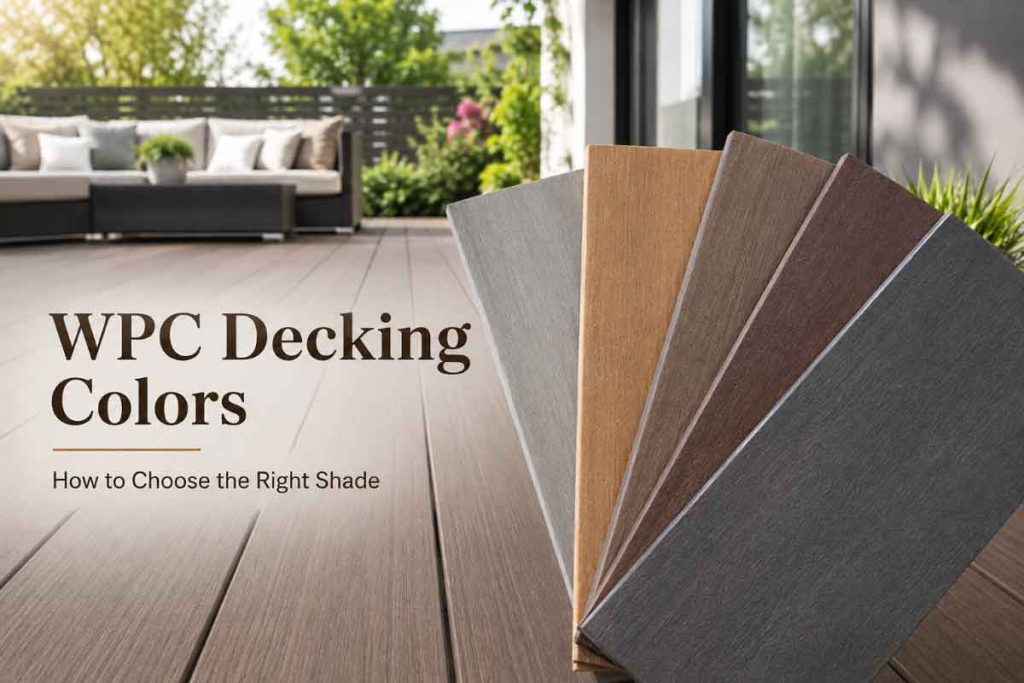
Which Colors Work Well for Restaurant Decking?
Color affects both appearance and maintenance.
Teak and Medium Brown
Medium wood tones can create a warm hospitality appearance.
They may also help hide:
- Dust
- Minor dirt
- Small surface marks
This makes them practical for many restaurant terraces.
Light Grey and Silver Grey
Grey can suit:
- Modern cafés
- Rooftop restaurants
- Contemporary hotels
Lighter colors may also absorb less solar heat than very dark colors under similar exposure.
However, some food and mud stains may appear more clearly.
Charcoal and Dark Colors
Dark decking creates a strong modern appearance.
However, buyers should consider:
- Greater heat absorption under strong sunlight
- Visibility of light-colored dust
- Visibility of some scratches
Therefore, color should be selected according to both design and operating environment.
Does WPC Decking Get Hot in Restaurant Outdoor Areas?
WPC decking exposed to direct sunlight can become warm or hot.
The final surface temperature depends on:
- Color
- Sun intensity
- Shade
- Climate
- Time of day
- Surface technology
Dark boards generally absorb more heat than lighter shades.
For restaurants in hot climates, consider:
- Light or medium colors
- Pergolas
- Umbrellas
- Awnings
- Trees
- Covered seating
Shade can make a significant difference to guest comfort.
Rooftop Restaurant Decking
Rooftop restaurants can create particularly demanding conditions.
The deck may experience:
- Strong sunlight
- Heat
- Wind
- Rain
- Large temperature changes
Therefore, rooftop projects should pay close attention to:
- Expansion gaps
- Substructure
- Drainage
- Fasteners
- Board color
- Wind-related site design
The decking should not be selected independently from the rooftop construction system.
WPC Decking for Outdoor Cafés
Café terraces may have lower grease exposure than BBQ restaurants but still experience:
- Coffee
- Drinks
- Food
- Chair movement
- Rain
- Daily cleaning
For these spaces, buyers may prioritize:
- Appearance
- Easy cleaning
- Comfortable colors
- Appropriate surface texture
Both traditional and capped WPC may be considered depending on budget and use.
WPC Decking for Hotel Restaurants
Hotel dining areas often place greater emphasis on long-term appearance.
They may also experience:
- High guest traffic
- Regular cleaning
- Furniture rearrangement
- Events
- Longer operating hours
For these environments, project buyers may place more value on:
- Surface consistency
- Stain resistance
- Replacement availability
- Matching accessories
- Batch control
The cheapest board is not always the lowest-cost option over the complete project lifecycle.
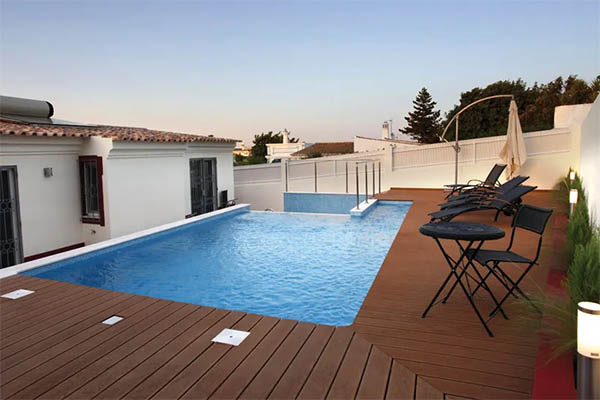
WPC Decking Around Poolside Restaurants
Poolside dining combines food service with frequent water exposure.
Important considerations include:
- Wet surface conditions
- Drainage
- Surface temperature
- Food and drink stains
- Moisture resistance
Where slip performance is particularly important, buyers should request appropriate product-specific information.
Avoid assuming that a wood-grain texture alone guarantees a particular wet slip result.
Restaurant Decking Maintenance Cost
Maintenance is one reason commercial buyers consider WPC.
Traditional timber restaurant decking may require periodic surface treatments depending on the wood and finish.
These can include:
- Painting
- Staining
- Oiling
- Sealing
- Refinishing
WPC normally does not require these routine timber-style treatments.
Its maintenance is more commonly focused on:
- Cleaning
- Drainage
- Debris removal
- Inspection
This can reduce certain recurring maintenance tasks.
However, WPC should still be described as low maintenance, not maintenance-free.
Why Maintenance Downtime Matters for Restaurants
Maintenance has an operational cost.
If a restaurant terrace needs significant surface treatment, the area may need to be:
- Partially closed
- Fully closed
- Cleared of furniture
This can affect normal service.
Therefore, project buyers should evaluate both:
maintenance expense
and:
maintenance disruption.
A product with a higher initial cost may sometimes provide better long-term value when it reduces recurring surface treatment.
However, this depends on actual project conditions.
Installation Quality Affects Restaurant Decking Performance
A good WPC board can still develop problems when installed incorrectly.
Important installation factors include:
- Joist spacing
- Expansion gaps
- Drainage
- Ventilation
- Fasteners
- Supported board ends
Commercial areas should follow the manufacturer’s installation instructions.
Do not use one universal joist-spacing figure for every profile unless the actual product specification supports it.
Why Expansion Gaps Matter
WPC expands and contracts as temperatures change.
This is especially important for:
- Sunny terraces
- Rooftops
- Large commercial decks
Suitable gaps should be provided around:
- Board ends
- Walls
- Columns
- Fixed structures
Insufficient clearance can create pressure between boards or surrounding structures.
Substructure Choice for Restaurant Decking
Possible substructures include:
- WPC joists
- Treated timber
- Aluminum
- Other suitable systems
The correct choice depends on the project.
Restaurant buyers should consider:
- Structural requirements
- Moisture
- Installation height
- Drainage
- Long-term maintenance
A durable surface board cannot compensate for an unsuitable or failing substructure.
How to Reduce Long-Term Restaurant Decking Problems
A few practical decisions can improve long-term performance.
Clean Spills Quickly
Food, oil and drinks are easier to manage before they remain on the deck for extended periods.
Use Furniture Pads
This can reduce scratches from moving tables and chairs.
Maintain Drainage
Keep board gaps and drainage routes clear.
Remove Debris
Leaves and food residue should not accumulate.
Follow Installation Guidance
Use the correct joist spacing, gaps and fastening method.
Keep Replacement Boards
Large restaurant projects may benefit from storing spare boards from the original production batch.
This can simplify later repairs.
Why Spare Boards Are Useful for Restaurants
Commercial spaces may occasionally suffer localized damage.
For example:
- Furniture impact
- Construction work
- Equipment damage
A single damaged board may be easier to replace than repair.
However, a new production batch can have slight color differences from older weathered boards.
Keeping several spare boards from the original order can make future replacement easier.
Restaurant WPC Decking vs Timber
Both materials can work in hospitality projects.
| Factor | WPC Decking | Timber Decking |
|---|---|---|
| Routine cleaning | Required | Required |
| Painting | Normally not required | May be required |
| Staining | Normally not required | May be required |
| Oiling | Normally not required | May be required |
| Splinter risk | Generally reduced | Can develop over time |
| Food stains | Depends on surface | Depends on finish |
| Surface scratches | Possible | Possible |
| Refinishing | Limited | Often possible |
| Color consistency | Controlled | Natural variation |
| Outdoor moisture resistance | Generally good | Depends on wood and treatment |
WPC’s main advantage is not that it requires no care.
It is that several routine timber-style surface treatments are generally unnecessary.
Traditional WPC vs Capped WPC for Restaurant Projects
| Factor | Traditional WPC | Capped WPC |
|---|---|---|
| Initial cost | Generally lower | Generally higher |
| Surface protection | Standard | Improved |
| Food stain resistance | Prompt cleaning important | Generally improved |
| Grease resistance | Depends on surface | Generally improved |
| Color stability | Depends on formulation | Generally improved |
| Cleaning convenience | Standard | Often improved |
| Restaurant use | Suitable for many areas | Useful for demanding areas |
This table should not be interpreted as saying capped decking is required for every restaurant.
It simply explains why capped surfaces may deserve greater consideration in high-stain environments.
What B2B Buyers Should Check Before Ordering Restaurant WPC Decking
Restaurant projects should be evaluated differently from ordinary residential decking.
1. Surface Technology
Confirm whether the product is:
- Traditional WPC
- Capped
- Co-extruded
2. Profile Structure
Check:
- Hollow
- Solid
- Dimensions
- Weight
3. Surface Texture
Compare:
- Straight grain
- Embossed
- 3D embossed
- Capped wood grain
4. Color
Consider:
- Design
- Heat
- Dirt visibility
- Scratch visibility
5. Slip-Related Information
Where required, ask for relevant test information for the actual product.
6. Stain Resistance
Restaurant buyers should specifically consider:
- Oil
- Grease
- Food
- Coffee
- Wine
7. Cleaning Instructions
The distributor should know which cleaning methods are recommended.
8. Joist Spacing
Use the manufacturer’s specification for the selected profile.
9. Accessories
Confirm:
- Joists
- Clips
- Screws
- Edge boards
10. Replacement Supply
Ask whether replacement boards can be supplied later.
Questions to Ask a WPC Manufacturer for a Restaurant Project
Before placing an order, buyers can ask:
- Is this product suitable for commercial outdoor applications?
- Is the board capped or uncapped?
- Is the profile hollow or solid?
- What surface textures are available?
- What stain-related information is available?
- Is wet slip test information available?
- How should oil and grease be cleaned?
- Which cleaners should be avoided?
- What joist spacing is recommended?
- What expansion gaps are required?
- What clips and screws should be used?
- Can physical samples be supplied?
- Can replacement boards be supplied later?
- What packaging is used for commercial orders?
These questions make supplier comparison more practical.
Physical Samples Are Important
For restaurant projects, a physical sample can provide more useful information than a catalog photograph.
Buyers can evaluate:
- Color
- Surface texture
- Grain depth
- Profile
- Weight
- Surface appearance
Where stain resistance is important, controlled sample evaluation can also help compare different surface technologies.
However, sample testing conditions should be consistent when comparing products.
Common Mistakes When Choosing Restaurant WPC Decking
Mistake 1: Choosing Only by Color
Appearance is important, but restaurant use also involves traffic, stains and cleaning.
Mistake 2: Assuming All WPC Is Suitable for Heavy Traffic
Different profiles have different structures and installation requirements.
Mistake 3: Calling Textured WPC Completely Slip-Proof
Wet conditions and contamination still affect surface grip.
Mistake 4: Ignoring Grease
BBQ and restaurant environments can expose decks to repeated oil contamination.
Mistake 5: Assuming Capped WPC Is Stain-Proof
It generally provides improved surface protection, but cleaning is still required.
Mistake 6: Dragging Furniture
Repeated chair and table movement can scratch the surface.
Mistake 7: Ignoring Drainage
Frequent cleaning makes effective drainage particularly important.
Mistake 8: Choosing Very Dark Colors Without Considering Heat
Outdoor dining terraces can become uncomfortable under strong sunlight.
Mistake 9: Calling WPC Maintenance-Free
Commercial WPC decking still needs routine cleaning and inspection.
Mistake 10: Not Keeping Spare Boards
Replacement may become more difficult after years of outdoor weathering.
Frequently Asked Questions
Is WPC Decking Good for Restaurants?
WPC decking can be suitable for restaurant terraces, cafés, BBQ restaurants and other outdoor dining areas when the surface, profile and installation match the project requirements.
Is Composite Decking Suitable for Heavy Restaurant Traffic?
It can be, but buyers should select the appropriate profile and substructure and follow the manufacturer’s installation requirements.
Is WPC Decking Slippery When Wet?
Wet conditions can affect any outdoor flooring surface. Grip depends on texture, contamination and product performance. Buyers should review relevant test information when slip performance is important.
Does Restaurant WPC Decking Stain?
Food, drinks, oil and grease can leave marks if not cleaned promptly. Capped WPC generally provides improved stain resistance compared with traditional uncapped decking.
Is Capped WPC Better for BBQ Restaurants?
It can be a useful choice because the protective surface generally improves resistance to oil, food stains and frequent cleaning. However, it is not stain-proof.
Can Restaurant Chairs Scratch WPC Decking?
Yes. Repeatedly dragging furniture can create scratches. Furniture pads and regular removal of grit can help reduce wear.
Is WPC Decking Easy to Clean?
Routine dirt can generally be cleaned using appropriate methods. Deep embossing may require more brushing than simpler surfaces.
Does WPC Decking Need Painting or Staining?
Routine painting and staining are generally unnecessary because the color and surface are created during manufacturing.
Is WPC Decking Maintenance-Free?
No. WPC decking is better described as low maintenance. It still needs cleaning, drainage management and periodic inspection.
What WPC Color Is Best for Restaurant Terraces?
There is no universal best color. Medium wood tones can hide some everyday dirt, while lighter colors may be useful in sunny environments. Selection should balance design, heat and maintenance.
Is WPC Suitable for Rooftop Restaurants?
Yes, depending on the product and rooftop structure. Expansion gaps, drainage, sunlight and substructure require particular attention.
Is WPC Suitable for Poolside Restaurants?
It can be used in poolside dining areas, but wet-surface conditions, drainage, temperature and appropriate product-specific slip information should be evaluated.
Should Restaurants Choose Hollow or Solid WPC?
Both can be suitable depending on the project. Buyers should compare profile structure, expected traffic, support spacing and installation requirements.
Should Restaurant Buyers Keep Spare Boards?
For large commercial projects, spare boards from the original production batch can make future repairs easier.
Conclusion
WPC decking for restaurants should be selected according to the way the space operates, not only according to appearance or board price.
Restaurant outdoor areas can expose decking to:
- High foot traffic
- Food and drinks
- Oil and grease
- Rain
- Cleaning water
- Furniture movement
- Strong sunlight
Therefore, buyers should evaluate surface technology, texture, profile structure, stain resistance, wet conditions, drainage and installation together.
Traditional WPC can provide a practical and economical solution for many restaurant projects.
Capped or co-extruded WPC may provide additional value where food stains, grease and frequent cleaning are important concerns.
However, neither option is maintenance-free, scratch-proof or completely slip-proof.
For restaurant project buyers, the most useful approach is to compare:
traffic + surface + stains + cleaning + drainage + installation + long-term maintenance
rather than selecting a board based on one feature.
Physical samples, clear installation instructions and appropriate technical information can also help reduce risk before bulk purchasing.
A well-selected WPC decking system can provide an attractive and practical outdoor dining surface for cafés, BBQ restaurants, hotels, resorts and other commercial hospitality spaces.