WPC decking clips play an important role in the stability, appearance, and lifespan of outdoor decking systems. Hidden clips are commonly used to fix decking boards while maintaining clean spacing and a modern surface appearance.
Today, the two most common materials used for WPC decking clips are plastic and stainless steel. Each material has different advantages, installation characteristics, and application scenarios.
Choosing the right clip material can affect structural stability, installation efficiency, maintenance costs, and long-term outdoor performance.
Why Decking Clips Matter
Decking clips help secure the decking boards to the joist system while allowing proper expansion and contraction.
A suitable clip system helps:
- Improve installation stability
- Maintain consistent board spacing
- Reduce visible screws
- Improve drainage and ventilation
- Support thermal expansion
- Extend decking lifespan
Incorrect clip selection may lead to:
- Loose boards
- Surface movement
- Noise while walking
- Fastener corrosion
- Installation failure over time
Plastic Clips for WPC Decking
Plastic clips are widely used in residential decking projects because they are lightweight, affordable, and easy to install.
Advantages of Plastic Clips
Lower Cost
Plastic clips are usually more economical than stainless steel clips, making them suitable for projects with limited budgets.
Corrosion Resistance
Plastic materials do not rust, which can be beneficial in humid outdoor environments.
Easier Installation
Plastic clips are lightweight and simple to handle during installation.
Reduced Surface Friction
Some plastic clip systems can slightly reduce friction caused by thermal expansion.
Disadvantages of Plastic Clips
Lower Structural Strength
Plastic clips are generally less durable under heavy loads and frequent movement.
Temperature Sensitivity
Extreme heat or long-term UV exposure may affect lower-quality plastic clips over time.
Limited Commercial Use
Plastic clips are more commonly used in residential projects rather than heavy commercial decking systems.
Stainless Steel Clips for WPC Decking
Stainless steel clips are widely used in high-end residential and commercial outdoor projects because of their strength and durability.
Advantages of Stainless Steel Clips
Higher Structural Stability
Stainless steel clips provide stronger fixing performance and better load resistance.
Better Long-Term Durability
High-quality stainless steel clips are highly resistant to deformation, pressure, and outdoor weather conditions.
Better Performance in Commercial Areas
They are commonly used for:
- Public walkways
- Restaurants
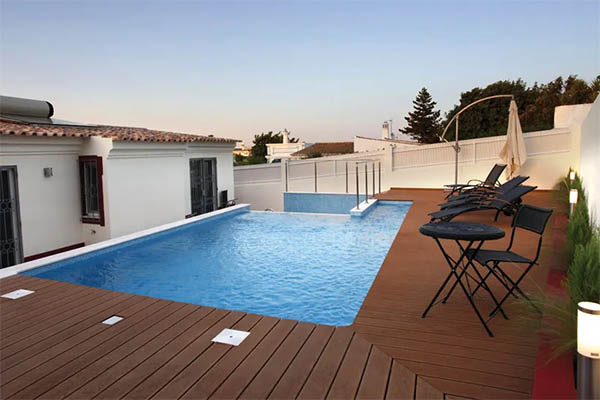
- Pool decks
- Scenic areas
- Commercial platforms
Stronger Wind Resistance
Metal clips usually hold decking boards more firmly in outdoor environments with strong wind conditions.
Disadvantages of Stainless Steel Clips
Higher Cost
Stainless steel clips are generally more expensive than plastic clips.
Potential Corrosion Risk
Low-quality stainless steel materials may still corrode in coastal or highly humid environments.
More Rigid Structure
Metal clips may provide less flexibility during thermal expansion compared with some plastic systems.
Which Clip Material Is Better?
The best choice depends on the project environment, budget, and expected lifespan.
Plastic Clips Are More Suitable For:
- Residential gardens
- Small balconies
- Light-load decking
- Budget-sensitive projects
Stainless Steel Clips Are Better For:
- Commercial projects
- Public walkways
- Poolside decking
- Heavy-load outdoor platforms
- Long-term outdoor applications
Factors to Consider When Choosing Decking Clips
Climate Conditions
Hot, humid, coastal, or high-UV environments may require stronger and more durable fastening systems.
Decking Board Type
Solid decking boards may require stronger support systems than hollow decking profiles.
Joist Material
Clip compatibility with aluminum joists or WPC joists should also be considered.
Installation Method
Different decking systems may use different hidden clip designs and spacing requirements.
Common Installation Mistakes
Some common decking clip problems include:
- Over-tightening screws
- Incorrect clip spacing
- Poor joist alignment
- Using low-quality stainless steel
- Mixing incompatible accessories
Proper installation is important for long-term decking performance.
Conclusion
Both plastic clips and stainless steel clips have their own advantages in WPC decking systems. Plastic clips are more economical and suitable for residential projects, while stainless steel clips provide stronger durability and stability for commercial and high-traffic outdoor environments.
Choosing the right decking clip system depends on the project budget, climate conditions, load requirements, and long-term maintenance expectations.