

Outdoor gardening is becoming increasingly popular worldwide, and many homeowners are starting to use engineered wood flooring to build elevated flower beds. Because engineered wood flooring is resistant to rot and mildew, and requires almost no maintenance, it is more durable than ordinary wood.
However, composite materials are not without their drawbacks. Before using wood-plastic composite boards to build flower beds, it’s necessary to understand its advantages and disadvantages. This article will analyze this from multiple perspectives, providing a comprehensive understanding of wood-plastic composite materials.
I. Can Engineered Wood Flooring Be Used to Build Elevated Flower Beds?
Short Answer: Yes, but it’s crucial to choose the correct board size and pay attention to the installation method.
Engineered wood flooring can be used to build elevated flower beds, but it cannot completely replace wood. This is because wood-plastic composite materials are not designed for flower beds. Therefore, its lateral soil pressure resistance is weaker than that of wood. If the sides are not properly reinforced, the boards may warp after being filled with wet soil.
In short: Wood-plastic composite boards are suitable for lower garden beds; longer or higher beds require additional reinforcement. Otherwise, they will warp outwards over time.
II. Advantages of Using Composite Wood in Garden Beds
1. Anti-corrosion, Anti-mildew, and Anti-insect
Traditional wood is prone to rotting when left outdoors for extended periods, especially in damp flower bed environments. Composite wood flooring, made from wood powder and plastic, does not absorb moisture. It is waterproof, insect-proof, anti-corrosion, and mildew-resistant, making it widely used in outdoor landscape design.
2. Long and Stable Service Life
Composite wood-plastic composite boards do not require painting or frequent replacement like natural wood. Most composite boards have a lifespan of around 10–20 years, making them virtually maintenance-free and reducing long-term costs.
3. Simple and Modern Appearance
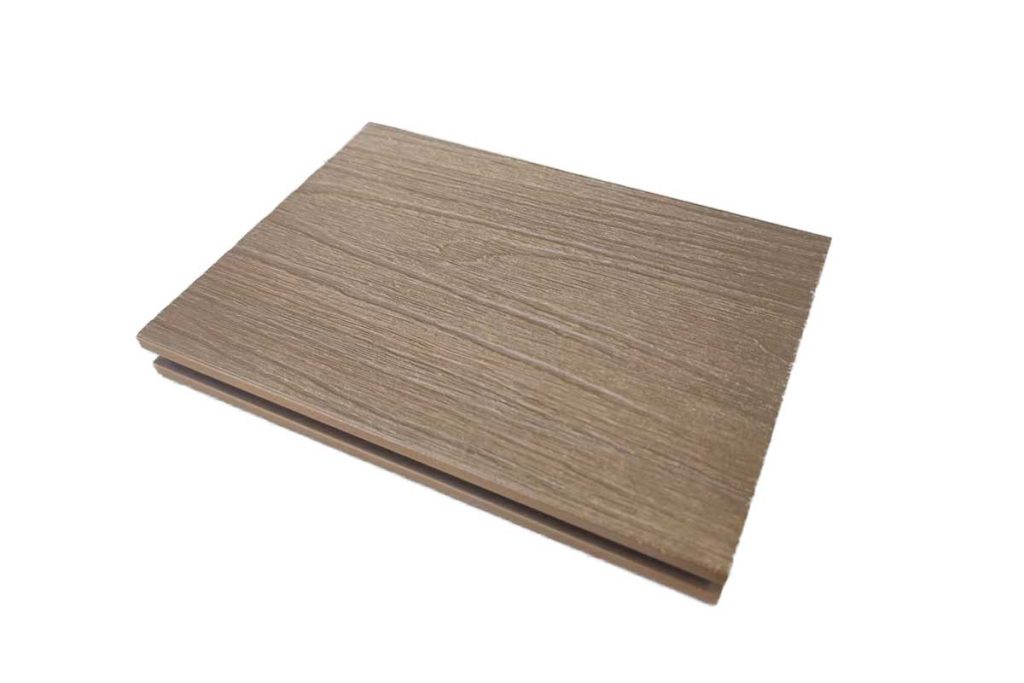
Composite boards have uniform color, smooth edges, and consistent texture. Unlike solid wood, they are free of knots, cracks, or warping. For landscape designers, composite materials offer a simpler, more modern look, making it easier to create a unified outdoor style.
4. Extremely Low Maintenance Costs
Natural wood requires annual oiling, sanding, and sealing. Composite wood flooring only requires simple cleaning, greatly reducing the time and effort needed for upkeep.
5. Environmentally Friendly and Sustainable
Composite wood decking typically contains 50–60% recycled wood fiber and 30–40% recycled plastic, making it more eco-friendly than timber produced from felled trees.
III. Key Considerations Before Using Composite Materials for Elevated Flower Beds
1. Composite Wood is Not a Structural Material
The biggest limitation is strength. Compared to natural wood, composite boards are more prone to bending under pressure. The longer the bed sides and the higher the bed surface, the greater the soil pressure it needs to withstand.
Recommendations:
- Bed height should be less than 40 cm.
- Beds longer than 1.2 meters must include lateral reinforcement.
Without proper support, the bed boards may bulge, warp, or crack over time.
2. Different Brands Use Different Material Compositions
While composite wood is generally safe, “food-grade” is not an industry standard. For vegetable cultivation, using protective padding is recommended:
- Install a food-grade waterproof membrane inside the flower bed.
- Avoid direct contact between soil and composite boards.
This improves safety and extends the lifespan of the boards.
3. Thermal Conductivity
Composite materials absorb and retain more heat, especially dark-colored boards. In summer, the soil temperature around a composite bed may be higher than that of a wooden bed. Heat-loving plants, such as tomatoes or peppers, grow well, but leafy vegetables may need shading to avoid poor growth.
IV. How to Properly Build an Elevated Flower Bed Using Composite Wood Flooring
Installation Steps:
- Install wooden or aluminum posts at each corner.
- Add horizontal supports every 60–100 cm to reinforce the sides.
- Line the inside with a waterproof protective film.
- Use stainless steel screws during assembly to prevent rust.
Recommended Bed Sizes:
- 120 cm × 60 cm × 30–40 cm (most stable)
- 180 cm × 60 cm (requires horizontal reinforcement)
- Heights exceeding 60 cm are not recommended without a sturdy internal frame.
Construction Notes:
- Composite boards can be cut like regular wood, but the exposed cut surface is softer.
- Posts must bear the structural load, not the panels alone.
- For larger beds, aluminum gussets offer better durability.
V. Expected Lifespan in Actual Outdoor Conditions
- Lifespan of composite flower beds: 10–20 years.
- Cold climates may reduce flexibility slightly.
- Hot climates may slightly shorten the lifespan of darker panels.
Durability Ranking:
Composite Wood > Preservative-Treated Wood > Natural Wood
VI. Conclusion: Composite Wood Flooring Performs Well—When Used Properly
Composite wood has a clean appearance, long lifespan, and is rot- and mildew-resistant, making it ideal for building elevated flower beds. It performs well in most modern gardens and requires almost no maintenance.
Key Takeaways:
✔ Suitable for low and medium-sized flower beds
✔ Simple and modern appearance
✔ Long lifespan, rot-resistant, low maintenance
However:
❗ Not suitable for tall or long flower beds without reinforcement
❗ Posts and supports are required for stability
❗ Protective lining is recommended for vegetable gardens
Wood-plastic composite flower boxes can be made from leftover flooring, or you can purchase boards specifically for this purpose. Contact us for the latest quote if interested.


