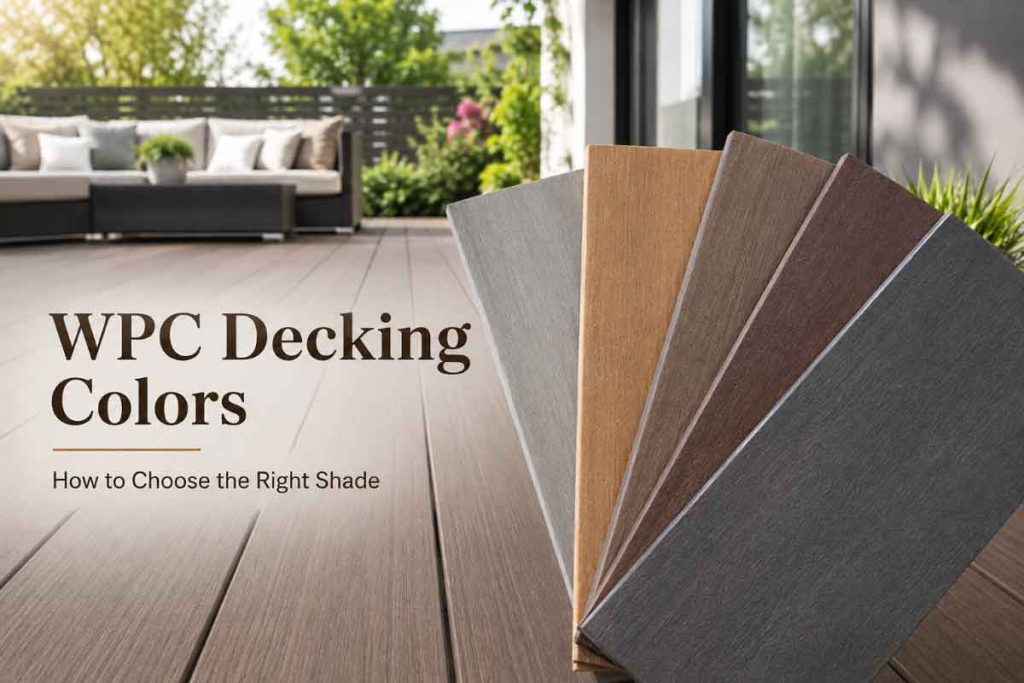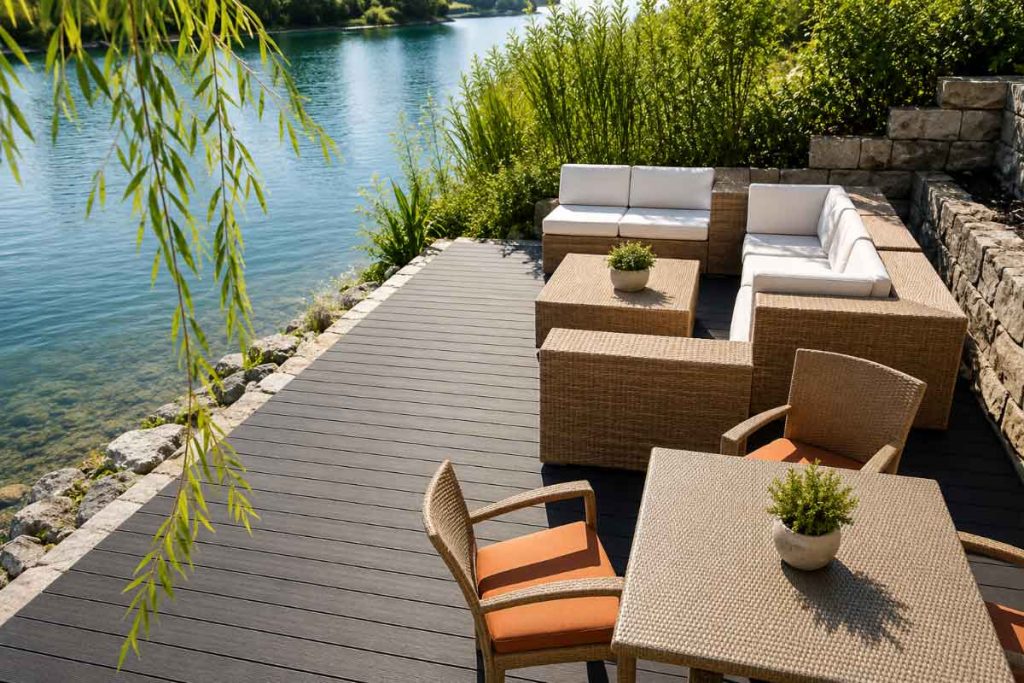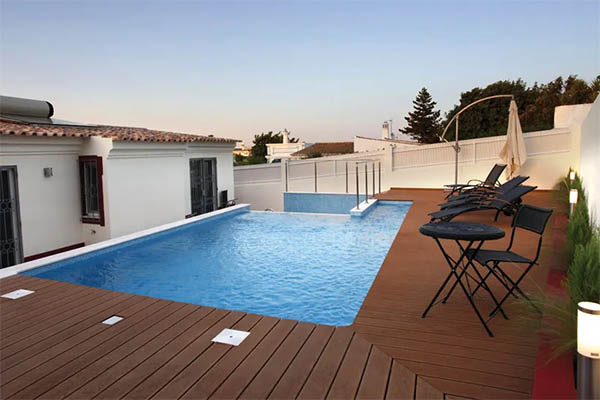
Weather resistant composite decking is designed to remain outdoors through rain, sunlight, humidity and changing temperatures.
That is one of the main reasons WPC decking is widely used for balconies, gardens, poolside areas, terraces, hotels and commercial outdoor spaces.
However, weather resistance does not mean that composite decking is completely unaffected by weather.
Outdoor decking still expands and contracts with temperature, becomes wet after rain, receives UV exposure and may experience snow, salt, wind or high humidity depending on the project location.
Therefore, buyers should evaluate weather resistance as a complete system rather than rely on one claim such as “waterproof” or “weatherproof.”
Product formulation, board structure, surface technology, installation, drainage and local climate all influence long-term outdoor performance.
This guide explains how composite decking performs under different weather conditions and what distributors, contractors and project buyers should check before choosing a WPC decking system.
What Does Weather-Resistant Composite Decking Mean?
Weather-resistant composite decking is designed to tolerate normal outdoor environmental exposure better than materials intended only for indoor use.
Typical outdoor conditions include:
- Rain
- Humidity
- Sunlight
- UV exposure
- Heat
- Cold
- Seasonal temperature changes
- Snow
- Coastal air
- Wind-driven moisture
A weather-resistant deck should maintain practical performance under these conditions when the product is correctly selected and installed.
However, weather-resistant does not mean completely immune to environmental effects.
Composite decking can still experience:
- Surface color adjustment
- Thermal expansion
- Thermal contraction
- Surface heating
- Dirt accumulation
- Moisture around the substructure
- Weather-related wear
Therefore, accurate product selection and installation remain important.
Weather-Resistant vs Waterproof vs Weatherproof
These terms are often used interchangeably, but they do not mean exactly the same thing.
Weather-Resistant
Weather-resistant means the material is designed to withstand normal outdoor conditions such as rain, sunlight and temperature changes.
This is the most appropriate general description for WPC decking.
Water-Resistant
Water-resistant means the material can resist moisture exposure better than many untreated natural materials.
WPC generally provides good resistance to outdoor moisture because polymer forms part of its structure.
However, the complete decking installation still requires drainage.
Weatherproof
Weatherproof suggests almost complete protection from weather.
This wording can be too absolute for outdoor decking because no installed deck is completely unaffected by climate, temperature or long-term exposure.
Therefore, manufacturers and distributors should normally use more precise terms such as:
weather-resistant
and:
water-resistant
rather than making broad “weatherproof” claims.
Why Composite Decking Performs Well Outdoors
WPC decking combines wood-based material with thermoplastic polymers and functional additives.
This engineered structure gives it several characteristics that are useful outdoors.
Compared with untreated natural timber, WPC generally provides stronger resistance to:
- Moisture absorption
- Rot
- Insect attack
- Traditional wood splintering
- Repeated surface refinishing
- Some weather-related dimensional changes
However, WPC is still an outdoor material affected by environmental conditions.
Its weather performance should therefore be evaluated according to the exact product and application.
How Does Composite Decking Perform in Rain?
Rain is one of the most common environmental conditions for outdoor decking.
WPC generally performs well under normal rainfall because the polymer component reduces direct moisture absorption compared with untreated natural wood.
This makes composite decking suitable for many exposed outdoor areas.
However, rain resistance depends on more than the board material.
Rainwater Must Be Able to Drain
Water should not remain trapped around the deck.
Correct installation should allow rainwater to move through board gaps and away from the substructure.
Important drainage areas include:
- Board gaps
- Wall edges
- Balcony outlets
- Deck perimeter
- Joist spaces
- Steps
- Corners
If drainage becomes blocked by leaves, soil or dirt, moisture may remain around the installation longer than intended.
Therefore, weather resistance depends partly on maintenance and installation design.
Standing Water Should Be Avoided
Composite decking can tolerate outdoor moisture, but permanent standing water is not desirable.
Long-term water accumulation can affect:
- Dirt buildup
- Surface cleanliness
- Fasteners
- Joists
- Substructure ventilation
- Algae growth
- Surrounding construction materials
The goal is not to stop rain from reaching the deck.
The goal is to allow the deck to dry properly after rain.
Can Composite Decking Be Used in Humid Climates?
Yes, WPC decking can be suitable for humid environments when the product and installation system are appropriate.
High humidity creates different conditions from occasional rainfall.
Moisture may remain in the surrounding air for longer periods, especially in shaded areas.
Therefore, humid-climate installations should pay particular attention to:
- Ventilation
- Drainage
- Organic debris
- Plant material
- Mold on surface dirt
- Fastener condition
- Substructure design
Why Ventilation Matters in Humid Areas
Airflow helps moisture escape from below the boards.
Without enough ventilation, damp conditions can remain beneath the deck after rainfall or cleaning.
Therefore, decks installed close to the ground should maintain appropriate clearance according to the project design.
The area below the boards should also remain free from accumulated leaves, soil and stored materials.
Can Mold Grow on Composite Decking?
WPC provides better resistance to biological decay than untreated natural wood, but mold can still grow on organic material sitting on the surface.
For example, mold may develop on:
- Wet leaves
- Soil
- Food residue
- Pollen
- Plant debris
- Surface dirt
This is particularly common in humid, shaded areas.
Therefore, keeping the deck clean remains important.
Weather resistance does not remove the need for routine cleaning.
How Does Composite Decking Handle Strong Sunlight?
Outdoor decking often receives hours of direct sunlight.
This exposes the surface to both UV radiation and heat.
Composite decking is manufactured for outdoor use, and suitable products normally contain pigments and additives designed to improve outdoor stability.
However, sunlight can still affect appearance over time.
Does Composite Decking Fade in the Sun?
Some color adjustment can occur after outdoor exposure.
The amount depends on factors such as:
- Product formulation
- Pigment system
- UV stabilizers
- Surface technology
- Color
- Local climate
- Exposure direction
- Duration of sunlight
Therefore, manufacturers should avoid absolute claims such as:
“Composite decking never fades.”
A more accurate statement is:
Quality WPC decking is designed for outdoor UV exposure, but some color adjustment may occur over time.
Why Dark and Light Colors Behave Differently in Sunlight
Color influences surface temperature.
Dark colors generally absorb more solar heat than light colors.
Therefore, charcoal, dark brown and similar shades may become warmer in strong direct sunlight.
Light grey, teak and medium tones may remain more comfortable in some sunny applications.
This can be particularly important for:
- Poolside decking
- Balconies
- Resorts
- Barefoot areas
- Hot-climate projects
However, color is only one factor.
Surface technology, airflow and exposure time also influence surface temperature.
Does UV Exposure Damage Composite Decking?
Long-term UV exposure can affect many outdoor materials.
In WPC decking, UV-resistant additives and surface technology help improve outdoor stability.
Capped decking can provide additional surface protection because the visible cap layer is specifically designed to protect the board surface.
However, UV exposure should still be considered during product selection.
Buyers should review available technical information rather than rely only on visual claims.
How Does Composite Decking Perform in Hot Weather?
WPC can be used in hot climates, but temperature changes affect the dimensions of the boards.
Like many polymer-containing materials, composite decking expands when heated.
Therefore, installation gaps are important.
Thermal Expansion in Hot Weather
As temperature rises, WPC boards may expand slightly.
The amount depends on:
- Board length
- Material formulation
- Profile design
- Temperature difference
- Color
- Installation method
Long boards can show more total dimensional movement than shorter boards.
Therefore, installers should follow the manufacturer’s recommended expansion gaps.
Why Expansion Gaps Matter
If boards are installed too tightly, they may push against:
- Walls
- Edging
- Other boards
- Fixed structures
This can create:
- Buckling
- Distortion
- Raised board ends
- Stress around fasteners
Correct spacing gives the boards room to move with temperature changes.
This is an installation issue rather than a sign that WPC is unsuitable for hot climates.
Do Hollow and Solid Boards React Differently to Heat?
Both hollow and solid WPC can experience thermal movement.
However, their structure, weight and cross-section are different.
Therefore, buyers should not assume that every profile has the same expansion behavior.
The exact board specification should be evaluated according to the manufacturer’s installation guidance.
Does Composite Decking Become Hot in Summer?
Yes, like other outdoor flooring materials, composite decking can become warm under direct sunlight.
Surface temperature depends on:
- Board color
- Sun exposure
- Ambient temperature
- Surface texture
- Airflow
- Product technology
Very dark boards may become noticeably warmer than lighter shades.
Therefore, project buyers should consider color and climate together.
How Does Composite Decking Perform in Cold Weather?
Composite decking can also be used in cold climates.
As temperatures fall, WPC contracts.
Therefore, temperature-related movement works in both directions.
In summer:
the board may expand
In winter:
the board may contract
Correct installation allows for both.
Can Cold Weather Make Composite Decking Brittle?
Low temperature can affect the behavior of polymer-based materials.
Therefore, product formulation and quality control are important for very cold regions.
However, users should not assume that all WPC products perform identically.
Projects in severe winter climates should review:
- Product specifications
- Installation recommendations
- Impact performance
- Joist spacing
- Fastener system
- Local project conditions
Can Composite Decking Be Used in Snow?
Yes, suitable composite decking can be used in snowy environments.
However, snow creates additional maintenance considerations.
Snow should be removed using methods that do not damage the surface.
Avoid aggressive tools that may scratch the board.
As snow melts, water should also be able to drain freely.
Therefore, board gaps and drainage channels should remain clear.
What About Ice?
Ice can make any outdoor deck slippery.
Therefore, winter maintenance should focus on:
- Removing snow carefully
- Preventing drainage blockage
- Avoiding unsuitable chemicals
- Following manufacturer recommendations
- Keeping walking areas clean
For de-icing products, buyers should confirm compatibility with the specific decking system.
How Does Composite Decking Handle Freeze-Thaw Cycles?
Freeze-thaw cycles occur when moisture repeatedly freezes and melts.
This can place stress on outdoor materials and surrounding construction systems.
WPC generally absorbs less moisture than untreated natural timber, which can be beneficial in such environments.
However, the complete deck must still manage moisture properly.
Problems can develop when water remains trapped around:
- Fasteners
- Joists
- edges
- drainage areas
- substructures
Therefore, drainage and ventilation remain important even in cold climates.
Can Composite Decking Be Used in Areas With Large Temperature Changes?
Yes, but temperature variation should be considered during installation.
Some regions may experience hot summers and freezing winters.
This means the decking system must accommodate a wide temperature range.
Important factors include:
- Expansion gaps
- End gaps
- Board length
- Joist spacing
- Clips
- Fastener design
- Perimeter clearance
The installer should use the recommended spacing for the expected project conditions.
How Does Composite Decking Perform in Coastal Weather?
Coastal environments combine several weather-related challenges.
These may include:
- Strong sunlight
- High humidity
- Salt deposits
- Wind
- Frequent moisture
- Sand
- Temperature variation
WPC can be suitable for coastal projects, but attention should also be paid to the complete installation system.
Salt and Surface Cleaning
Salt deposits can accumulate on exposed surfaces.
Periodic rinsing can help reduce buildup.
This is particularly useful for:
- Beachfront hotels
- Coastal villas
- Seaside restaurants
- Boardwalk-style projects
Fasteners Matter in Coastal Projects
The decking board may resist moisture well, but the metal accessories also need to suit the environment.
Corrosion-resistant clips and screws should be considered where salt exposure is significant.
Therefore, weather resistance should be evaluated for:
decking + joists + clips + screws
rather than the board alone.
How Does Composite Decking Handle Heavy Rain?
Heavy rain increases the importance of drainage.
A deck exposed to occasional light rain and one exposed to monsoon conditions may require different installation planning.
For heavy-rain regions, buyers should evaluate:
- Surface slope
- Board gaps
- Drainage channels
- Substructure clearance
- Ground drainage
- Wall drainage
- Ventilation
A weather-resistant board cannot compensate for a badly designed drainage system.
Can Composite Decking Be Used in Tropical Climates?
Yes, WPC is commonly considered for tropical outdoor environments.
However, tropical climates often combine:
- High temperature
- High humidity
- Strong UV
- Heavy rainfall
- Plant debris
- Biological growth
Therefore, these projects require balanced consideration.
Important priorities include:
- Good drainage
- Ventilation
- Suitable color
- UV-resistant formulation
- Surface cleaning
- Fastener quality
Can Composite Decking Be Used in Dry and Desert Climates?
Yes, but dry climates bring different challenges.
These may include:
- Strong UV
- High daytime temperatures
- Dust
- Large day-night temperature differences
- Low humidity
In these environments, expansion planning and color selection become particularly important.
Light and medium colors may be more comfortable for highly exposed areas.
Dust may also require regular cleaning.
How Does Wind Affect Composite Decking?
Wind itself normally does not damage properly installed decking boards under ordinary conditions.
However, wind can carry:
- Sand
- Dust
- Salt
- Leaves
- Debris
This can affect surface cleanliness.
More importantly, elevated decks, rooftop terraces and exposed commercial projects must be designed according to appropriate structural requirements.
WPC weather resistance should not be confused with the structural wind-load performance of the entire deck system.
What About Storms and Extreme Weather?
Composite decking is designed for outdoor exposure, but extreme weather requires project-specific evaluation.
Storm performance depends on:
- Structural frame
- Joist design
- Fasteners
- Anchoring
- Building structure
- Local codes
- Installation quality
Therefore, a board’s general weather resistance does not automatically prove that an entire deck can withstand a specific hurricane, typhoon or storm-load requirement.
Project buyers should review applicable structural requirements separately.
Capped vs Uncapped Composite Decking in Weather
Surface technology can influence outdoor performance.
One major distinction is between traditional uncapped WPC and capped composite decking.
Traditional Uncapped WPC
Traditional WPC exposes the composite material directly at the surface.
It can provide good outdoor performance and is suitable for many standard applications.
However, the visible surface is more directly exposed to:
- Sunlight
- Rain
- Dirt
- Food
- Stains
Therefore, cleaning and maintenance practices remain important.
Capped Composite Decking
Capped or co-extruded decking includes an additional protective surface layer.
This cap can improve:
- Stain resistance
- Surface moisture resistance
- Color stability
- Surface protection
- Weathering resistance
Therefore, capped decking may be preferred for premium or demanding outdoor environments.
Typical applications include:
- Hotels
- Resorts
- Poolside areas
- Restaurants
- Commercial terraces
- High-use residential projects
However, capped does not mean maintenance-free or completely weatherproof.
The complete installation still requires drainage and ventilation.
Three-Side vs Four-Side Capped Decking
Some capped products use protection on three sides, while others use four-side coverage.
The exact construction depends on product design.
Buyers should confirm:
- Which surfaces are capped
- How cut ends are handled
- Recommended applications
- Installation requirements
The amount of cap coverage should not be evaluated independently from the overall product design.
Hollow vs Solid WPC in Outdoor Weather
Hollow and solid describe internal board structure rather than surface weather technology.
Therefore, both hollow and solid profiles can be designed for outdoor use.
Hollow WPC Decking
Hollow boards can offer:
- Lower weight
- Reduced material use
- Efficient shipping
- Competitive cost
However, profile structure and joist spacing should match the intended application.
Solid WPC Decking
Solid boards contain more material and may provide a heavier profile.
They may be selected for projects requiring a different structural feel or usage condition.
However, solid does not automatically mean “more weather-resistant.”
Weather performance depends on:
- Material formulation
- Surface technology
- Installation
- Drainage
- climate
Therefore, buyers should compare the complete specification.
How Surface Texture Affects Weather Exposure
Surface texture influences both appearance and maintenance.
Straight-Grain Surface
Straight-grain decking usually has relatively simple lines.
Water and dirt can be easier to remove from some straight-grain surfaces.
Deep Embossed Surface
Deep embossing creates stronger wood-grain appearance.
However, deeper texture can hold more dust or dirt.
Therefore, cleaning may require a soft brush.
Co-Extruded Wood Grain
Capped wood-grain surfaces combine surface protection with decorative texture.
They can provide a premium appearance while improving stain and weather resistance.
However, deep texture still needs cleaning.
Does Weather Resistance Affect Decking Lifespan?
Yes, weather exposure is one of several factors affecting long-term service.
However, weather alone does not determine lifespan.
Other important factors include:
- Material quality
- Board structure
- Installation
- Joist spacing
- Drainage
- Ventilation
- Traffic
- Maintenance
- Climate
A well-designed deck in a demanding climate may perform better than a poorly installed deck in a mild climate.
Therefore, buyers should avoid judging lifespan only from one weather-resistance claim.
How Installation Affects Weather Resistance
Installation is one of the most important factors.
Even a high-quality WPC board can experience problems when installed incorrectly.
Correct Joist Spacing
Joists support the decking boards.
If spacing is too wide, boards may flex more than intended.
This can create long-term movement issues.
Therefore, joist spacing should match the exact board profile.
Correct Expansion Gaps
WPC moves with temperature.
Appropriate end and side gaps help accommodate expansion and contraction.
Insufficient gaps may create pressure against surrounding structures.
Correct Board Gaps
Board gaps support:
- Drainage
- Ventilation
- Thermal movement
If gaps are too small or become blocked, water may remain on or below the deck.
Suitable Substructure
The substructure should be:
- Stable
- Level
- Properly spaced
- Suitable for outdoor conditions
- Designed for drainage
Weather resistance depends heavily on what happens below the visible boards.
Correct Fasteners
Clips and screws should match:
- Board groove
- Joist type
- Project environment
- Moisture exposure
Corrosion resistance becomes particularly important in coastal and poolside environments.
Proper Drainage
Water should be directed away from the deck.
This may involve:
- Deck slope
- Drainage outlets
- Ground preparation
- Open gaps
- Ventilation spaces
Good drainage can reduce many weather-related problems.
What Maintenance Supports Weather Resistance?
Weather-resistant decking still needs routine care.
The goal is simple: allow the deck to remain clean and dry properly after outdoor exposure.
Useful maintenance includes:
- Remove leaves
- Sweep dust
- Clean stains
- Keep gaps open
- Check drainage
- Inspect fasteners
- Remove organic debris
- Check damaged boards
- Keep ventilation areas clear
Maintenance frequency depends on climate and project use.
Weather Resistance in Different Applications
Different projects expose decking to different weather conditions.
Residential Gardens
Garden decks may experience:
- Leaves
- Soil
- Rain
- Shade
- Plant moisture
Medium wood tones and practical drainage are often useful.
Regular cleaning helps prevent organic debris from remaining wet on the surface.
Balconies
Balconies may receive:
- Strong sunlight
- Wind
- Rain
- Limited drainage
Drain outlets should remain clear.
Expansion gaps around walls are also important.
Rooftop Terraces
Rooftop projects can experience stronger sun and wind exposure.
Therefore, buyers should evaluate:
- Structural support
- Drainage
- Heat
- Wind-related design
- Expansion space
The complete rooftop system should be reviewed according to project requirements.
Poolside Decking
Poolside areas experience:
- Frequent water
- Barefoot traffic
- Strong sunlight
- Cleaning chemicals
- Humidity
Important considerations include:
- Surface temperature
- Drainage
- Slip-related performance
- Fastener corrosion resistance
- Surface cleaning
Weather resistance is only one part of poolside product selection.
Hotels and Resorts
Hotels may operate in tropical, coastal or high-sun environments.
Therefore, project buyers should consider:
- UV exposure
- Foot traffic
- Cleaning frequency
- Stain resistance
- Replacement stock
- Color consistency
Capped decking may be worth evaluating for high-use hospitality projects.
Restaurant Terraces
Restaurant decking often faces:
- Rain
- Sun
- Food
- Oil
- Furniture
- Frequent cleaning
In these projects, stain resistance may be just as important as weather resistance.
Commercial Walkways
Commercial areas require attention to both weather and traffic.
Buyers should evaluate:
- Board profile
- Joist spacing
- Surface wear
- Fasteners
- Drainage
- maintenance access
What Should B2B Buyers Check Before Ordering Weather-Resistant Composite Decking?
B2B buyers should avoid choosing outdoor decking based only on marketing phrases.
Several technical and commercial factors should be reviewed.
Product Structure
Confirm whether the decking is:
- Hollow
- Solid
- Traditional WPC
- Capped WPC
- Straight grain
- Embossed
- Co-extruded
Board Dimensions
Dimensions influence:
- Weight
- Loading
- Joist spacing
- Profile strength
- Installation
Always compare exact specifications.
Surface Technology
Ask whether the visible surface is:
- Uncapped
- Three-side capped
- Four-side capped
- Single color
- Mixed color
Water Resistance Information
Ask how the exact product performs under moisture exposure.
Do not rely only on the word “waterproof.”
Weathering Information
Where available, review relevant test data or technical documentation related to:
- UV exposure
- Water absorption
- Dimensional stability
- Temperature performance
- mechanical performance
Recommended Installation Gaps
Buyers should obtain installation instructions before project installation.
Expansion gaps may vary according to:
- Board profile
- Length
- Climate
- Installation temperature
Recommended Joist Spacing
Joist spacing should match the specific board.
Do not copy spacing from another product without confirmation.
Suitable Fasteners
Check whether the project requires:
- Plastic clips
- Stainless steel clips
- Stainless steel screws
- Aluminium joists
- WPC joists
- Other substructure systems
Climate
Tell the supplier where the project will be installed.
Relevant conditions may include:
- Tropical climate
- Desert climate
- Coastal climate
- Cold winter
- Heavy rain
- High humidity
- Strong sunlight
This helps the supplier recommend a more appropriate product system.
Samples
Physical samples can help buyers evaluate:
- Color
- Texture
- Profile
- Weight
- Surface technology
However, a small sample cannot fully simulate long-term outdoor weathering.
Therefore, samples should be combined with technical review.
Common Mistakes When Evaluating Weather-Resistant Composite Decking
Several misunderstandings can lead to poor product selection.
Mistake 1: Assuming Weather-Resistant Means Waterproof
Weather resistance covers more than moisture.
A product can resist rain but still require drainage and expansion gaps.
Mistake 2: Ignoring Thermal Expansion
WPC contains polymer and responds to temperature changes.
Correct installation gaps are essential.
Mistake 3: Focusing Only on the Visible Board
The complete deck also includes:
- Joists
- Clips
- Screws
- Ground
- Drainage
A weak substructure can create problems even when the board performs well.
Mistake 4: Assuming Capped Decking Needs No Maintenance
Capped decking improves surface protection but still needs cleaning and inspection.
Mistake 5: Using One Product for Every Climate
Different climates create different priorities.
For example:
Hot climate → heat and expansion
Humid climate → drainage and ventilation
Coastal climate → salt and fasteners
Cold climate → contraction and snow
Mistake 6: Ignoring Color
Dark colors may become warmer under direct sunlight.
Therefore, color should be considered for poolside and barefoot areas.
Mistake 7: Relying Only on Marketing Claims
Terms such as:
- weatherproof
- waterproof
- maintenance-free
- never fades
should be treated carefully.
Technical information and realistic application guidance are more useful.
Frequently Asked Questions
Is composite decking weather-resistant?
Yes. WPC decking is designed for outdoor use and generally provides good resistance to rain, humidity, sunlight and changing temperatures. However, performance depends on product quality, installation, drainage and climate.
Is composite decking waterproof?
Composite decking is better described as water-resistant rather than completely waterproof. The board resists outdoor moisture, but the complete decking system still requires drainage.
Can composite decking stay outside all year?
Suitable outdoor WPC decking is designed for year-round exterior use. However, installation and maintenance should match the local climate.
Can composite decking handle heavy rain?
Yes, provided the decking system has adequate drainage, ventilation and installation gaps. Water should not remain trapped around the substructure.
Does composite decking fade in sunlight?
Some color adjustment may occur after outdoor exposure. The amount depends on pigments, UV protection, surface technology and climate.
Does composite decking expand in hot weather?
Yes. WPC can expand as temperatures rise. Proper expansion gaps should be included during installation.
Does composite decking contract in cold weather?
Yes. Lower temperatures can cause contraction. Correct installation spacing should allow for seasonal movement.
Can composite decking be used in snow?
Yes, suitable WPC decking can be used in snowy climates. Snow removal, drainage and winter maintenance should be handled carefully.
Can composite decking be used near the sea?
Yes, WPC can be suitable for coastal environments. Buyers should also consider salt deposits, humidity and corrosion-resistant fasteners.
Is capped composite decking more weather-resistant?
Capped decking generally provides improved surface protection, stain resistance and color stability compared with traditional uncapped WPC. However, it still requires correct installation and maintenance.
Is solid composite decking more weather-resistant than hollow decking?
Not necessarily. Hollow and solid describe internal structure. Weather resistance also depends on formulation, surface technology, installation and climate.
Can composite decking withstand extreme weather?
WPC can perform well outdoors, but extreme storms, wind loads and structural requirements must be evaluated at the complete deck-system level.
Conclusion
Weather resistant composite decking is designed to handle the environmental conditions that come with outdoor use.
Rain, humidity, sunlight, heat and cold do not automatically make WPC unsuitable for an exterior project.
Its engineered wood-plastic structure generally provides strong moisture resistance and better resistance to rot than untreated natural timber.
However, weather resistance should not be confused with complete immunity to weather.
Composite decking can still experience thermal expansion, contraction, surface heating, color adjustment and normal outdoor wear.
The final performance depends on several factors:
- Material formulation
- Board structure
- Surface technology
- Installation
- Expansion gaps
- Joist spacing
- Drainage
- Ventilation
- Fasteners
- Climate
- Maintenance
For buyers in rainy or humid markets, drainage and ventilation are particularly important.
For hot and sunny regions, UV resistance, color and thermal expansion deserve more attention.
For cold climates, contraction, snow and drainage should be considered.
Meanwhile, coastal projects should also evaluate salt exposure and fastener corrosion resistance.
Capped composite decking can provide additional surface protection for demanding environments, while traditional WPC remains suitable for many standard outdoor applications.
The key is not to look for a product described as completely “weatherproof.”
Instead, buyers should select a WPC decking system whose material, profile, surface technology and installation method match the actual outdoor conditions of the project.
Looking for Weather-Resistant Composite Decking?
Senlai manufactures WPC decking for residential, commercial and outdoor projects, including traditional, 3D embossed, hollow, solid and co-extruded decking options.
Multiple profiles, surface textures and colors are available for distributors, contractors and project buyers.