

When choosing outdoor decking, many people get confused by terms like “WPC co-extrusion,” “first generation,” “second generation,” “straight grain,” and “embossed texture.”
Among them, single-sided co-extruded WPC decking is often misunderstood as an “incomplete” or lower-grade option. In fact, it is a practical and cost-effective choice.
In this article, we’ll explain it in the simplest way. Whether you are new to renovation or just starting to learn about WPC decking, you will clearly understand what it is, why it’s useful, and how to choose it.
1. What Is Single-Sided Co-Extruded WPC Decking?
To understand this product, let’s first look at two basic concepts:
1) WPC Decking
WPC (Wood Plastic Composite) decking is made from wood fiber, plastic particles (usually PE), and eco-friendly additives, processed under high temperature.
It combines:
- The natural texture of wood
- The waterproof and moisture-resistant properties of plastic
Unlike traditional solid wood decking, it does not require regular painting or maintenance, making it a popular choice for outdoor use.
2) Co-Extrusion Technology
Co-extrusion can be understood as adding a “protective layer” to the decking.
It uses two extruders working together to combine different materials in one process:
- The outer layer is a dense polymer layer (usually ASA or PVC)
- The inner layer is standard WPC core material
This outer layer helps resist UV, stains, and moisture.
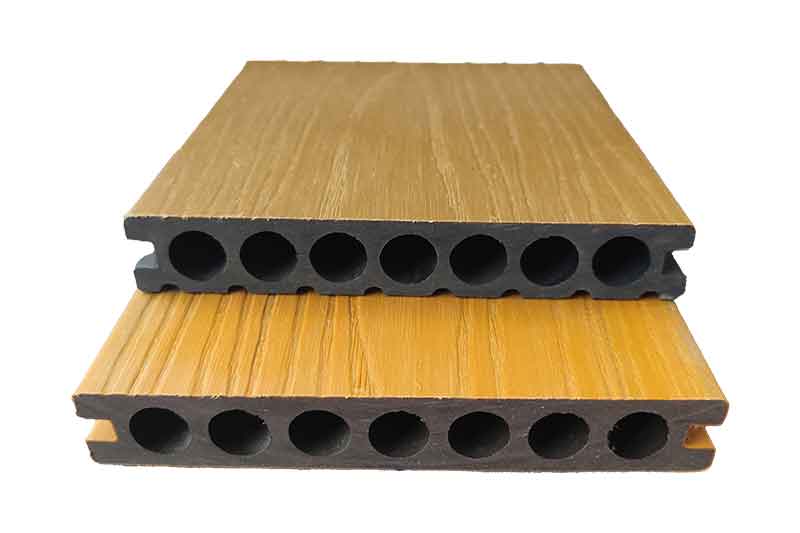
So What Does “Single-Sided” Mean?
Single-sided co-extruded WPC decking means:
- Only the front (visible surface) has the protective co-extruded layer
- The back side remains standard WPC material
It is also known as:
- Single-sided co-extruded decking
- One-side capped WPC decking
This is not a “cut-down version,” but a design optimized for cost and real usage needs.
2. Structure: One Protective Surface + One Base Layer
The structure of single-sided co-extruded decking is simple and functional.
(1) Two-Layer Structure
Top Layer (Surface Layer)
- Includes co-extruded protective layer + texture layer
- Thickness: about 0.5–1.2 mm
Functions:
- UV resistance (prevents fading)
- Stain resistance (easy cleaning)
- Wear resistance
The texture layer determines the visual appearance.
Bottom Layer (Base Layer)
- Standard WPC core material
- Usually smooth or lightly textured
Functions:
- Provides structural support
- Maintains stability
- Reduces cost
Since the bottom side is not exposed, it does not require a protective layer.
Important Note
No matter which texture is used, the co-extruded layer fully covers the surface.
This means:
- The texture is protected
- The appearance lasts longer
- It avoids fading, wear, or deformation
(2) Common Surface Texture Options
The surface design can be flexibly selected based on different styles:
1. Straight Grain + Co-Extrusion
- Clean and simple linear design
- Similar to minimalist wood flooring
- Suitable for modern, Nordic, or Japanese styles
It is also easy to clean due to its shallow texture.
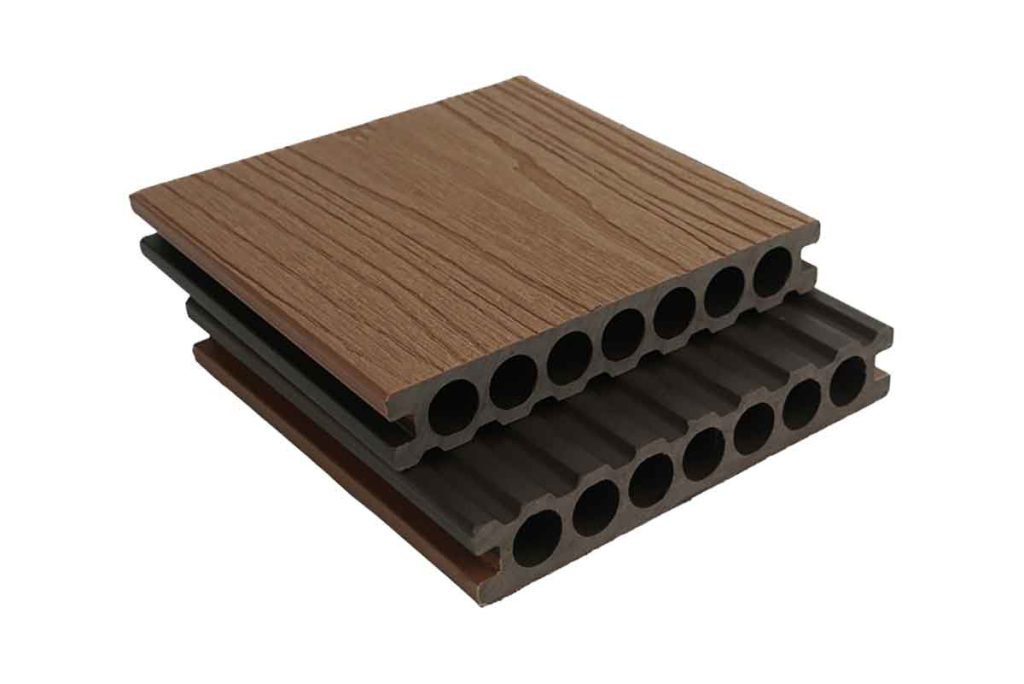
2. Embossed Wood Grain + Co-Extrusion
- Realistic wood patterns (oak, walnut, pine, etc.)
- Natural and warm appearance
- Suitable for classic, American, or traditional styles
With the co-extruded layer, the texture remains clear over time and does not fade easily.
3. Fine Brushed / Sanded Texture + Co-Extrusion
- Subtle matte surface
- Excellent anti-slip performance
- Ideal for wet areas such as balconies, gardens, and poolside
It also helps hide minor scratches and is very practical.
Summary
No matter which texture you choose, the core structure remains:
- Protected surface + structural base layer
The difference is mainly visual, not functional.
3. Key Advantages (Beginner-Friendly)
For most users, decking should be:
👉 Durable
👉 Easy to maintain
👉 Cost-effective
Single-sided co-extruded WPC decking meets all these needs.
1. High Cost Performance
- 20–30% cheaper than double-sided co-extruded decking
- More durable than standard WPC
The top layer protects against:
- UV
- Moisture
- Wear
This extends service life by 3–5 years compared to regular WPC.
2. Good Appearance & Style Flexibility
- Multiple texture options
- Suitable for different design styles
The co-extruded layer also helps maintain color stability over time.
3. Low Maintenance
- No painting or sealing required
- Easy cleaning with water
- Resistant to moisture, mold, and insects
Ideal for users who want a “low-effort” solution.
4. Easy Installation
- Compatible with standard joists and clips
- Same installation as regular WPC decking
- Can be installed by normal construction teams
It also saves time and labor cost.
5. Suitable for Most Outdoor Scenarios
Although the bottom has no protective layer:
- It is not exposed to sunlight or rain
- It does not affect performance
Suitable for:
- Balconies
- Patios
- Gardens
- Outdoor leisure areas
4. Common Misunderstandings
Misunderstanding 1: Is it a lower-quality product?
No. It is designed based on actual usage needs, not cost-cutting.
Misunderstanding 2: Will the back side age easily?
No. The back side is usually installed on joists or ground and not exposed to weather.
As long as installation is proper and ventilation is maintained, it will perform well for years.
Additional Tips
When purchasing, pay attention to:
- Co-extrusion layer thickness (≥ 0.5 mm recommended)
- Core density (higher density = better durability)
Also, request samples to check:
- Surface texture
- Layer bonding quality
5. Conclusion: Who Is It Suitable For?
Single-sided co-extruded WPC decking is ideal for:
- Buyers with limited budget
- Outdoor spaces where only the top surface is exposed
- Users who want low-maintenance decking
- Projects requiring flexible design styles
Final Thoughts
Single-sided co-extruded WPC decking is not an “incomplete product,” but a practical solution designed for real needs.
It combines:
- The durability of co-extruded decking
- The affordability of standard WPC
Without complicated choices or high costs, it offers a simple, reliable solution for outdoor spaces.


