When comparing solid vs hollow WPC decking, many buyers start with a simple assumption:
Solid decking is stronger and better, while hollow decking is simply the cheaper option.
In reality, the difference is more complicated.
Solid and hollow describe the internal profile structure of a composite decking board. They do not, by themselves, determine overall product quality.
A hollow WPC decking board with a well-designed internal structure and suitable support can be a practical choice for many residential and outdoor projects. Meanwhile, a solid board may be useful where a particular profile, project condition or performance requirement justifies the additional material.
The correct question is therefore not:
“Is solid WPC decking better than hollow decking?”
A better question is:
“Which profile is more suitable for my application, support system, budget and project requirements?”
What Is Solid WPC Decking?
Solid WPC decking has a substantially solid composite cross-section rather than large internal chambers.
The profile contains more composite material across the board body.
As a result, a comparable solid profile will generally have:
- Higher material usage
- Higher board weight
- A different structural response
- A higher initial material cost
However, solid WPC decking should not automatically be treated as a structural beam.
Its actual performance still depends on factors such as:
- Board dimensions
- Material formulation
- Profile design
- Joist support
- Span
- Load conditions
- Installation
The term solid tells buyers what the cross-section looks like. It does not tell them everything about the finished product.
What Is Hollow WPC Decking?
Hollow WPC decking contains chambers running through the internal profile.
Depending on the design, these chambers may be:
- Round
- Rectangular
- Square
- Other engineered shapes
The purpose of the hollow structure is generally to reduce material usage and board weight while maintaining a profile suitable for its intended application.
Compared with a similar solid profile, hollow decking can often provide:
- Lower weight
- Easier handling
- Lower material consumption
- More economical pricing
However:
Hollow does not mean weak or low quality.
A hollow profile still needs to be evaluated according to its:
- External dimensions
- Wall structure
- Chamber design
- Material
- Support conditions
Solid vs Hollow WPC Decking: Quick Comparison
| Factor | Solid WPC Decking | Hollow WPC Decking |
|---|---|---|
| Internal Structure | Substantially solid composite cross-section | Internal chambers |
| Material Usage | Generally higher | Generally lower |
| Weight | Usually heavier | Usually lighter |
| Initial Cost | Often higher | Often more economical |
| Handling | Heavier to transport and move | Easier to handle |
| Profile Design | Solid body | Chamber geometry matters |
| Residential Use | Suitable | Common and practical |
| Commercial Use | May suit selected demanding applications | Also possible depending on profile |
| Surface Technology | Can be capped or uncapped | Can be capped or uncapped |
| Installation Support | Product-specific | Product-specific |
| Overall Quality | Depends on complete product | Depends on complete product |
The most important point is that solid/hollow and capped/uncapped describe two different characteristics.
Is Solid WPC Decking Stronger Than Hollow Decking?
Not automatically.
A solid profile usually contains more material than a hollow profile of similar overall dimensions.
That can influence:
- Weight
- Stiffness
- Profile behavior
However, actual decking performance depends on much more than whether the board is solid or hollow.
Important factors include:
- Board width
- Board thickness
- Material formulation
- Profile geometry
- Hollow wall design
- Joist spacing
- Support conditions
- Load
- Temperature
Therefore, it would be inaccurate to say:
All solid decking is stronger than all hollow decking.
A well-designed hollow profile may perform better for a particular application than a poorly designed solid product.
Buyers should compare actual specifications rather than relying on the word “solid.”
Is Hollow WPC Decking Weak?
No.
Hollow WPC decking is widely used for outdoor applications because internal chambers can reduce unnecessary material while maintaining an engineered decking profile.
Quality hollow decking should be evaluated through:
- Cross-section
- Wall thickness
- Chamber geometry
- Overall dimensions
- Material consistency
- Manufacturer guidance
The presence of holes does not itself indicate poor quality.
A more useful question is:
How was the hollow profile designed, and what application was it designed for?
Does the Number of Holes Determine WPC Decking Quality?
No.
Buyers sometimes compare hollow decking by asking:
- Does it have six holes?
- Seven holes?
- Square holes?
- Round holes?
The number of chambers alone does not determine quality.
A profile with more chambers is not automatically better.
A profile with fewer chambers is not automatically weaker.
Manufacturers design internal profiles according to factors such as:
- Board dimensions
- Wall arrangement
- Material distribution
- Extrusion design
- Intended support conditions
Therefore, chamber count should be considered together with the complete cross-section.
Round Holes vs Square Chambers
Different WPC decking manufacturers may use different hollow structures.
Round-Hole Profiles
Round chambers are commonly used in hollow decking designs.
Square or Rectangular Chambers
Other profiles may use square or rectangular cavities.
Neither chamber shape can be declared universally better without considering the rest of the profile.
Buyers should inspect:
- Wall consistency
- Board dimensions
- Total profile geometry
- Recommended application
rather than selecting a decking board only by chamber shape.
How Important Is Wall Thickness in Hollow WPC Decking?
Wall thickness is an important profile characteristic, but it should not be judged in isolation.
A thicker wall can mean more material in certain parts of the board.
However:
Thicker wall ≠ automatically better decking.
The board should also be evaluated according to:
- Overall dimensions
- Chamber design
- Material formulation
- Joist support
- Intended application
For example, two hollow decking boards may have similar outer dimensions but very different internal structures.
Looking at only one wall measurement would not provide a complete comparison.
Solid vs Hollow WPC Decking Weight
One of the most obvious differences between the two profiles is weight.
Solid WPC decking generally weighs more because more composite material is present across the cross-section.
Hollow WPC decking reduces material through internal chambers.
This lower weight can make hollow boards easier to:
- Carry
- Move on site
- Load
- Install
However, weight alone should not be used as a quality score.
A heavier board may simply contain more material.
It does not automatically mean:
- Better surface
- Better color stability
- Better formulation
- Better manufacturing consistency
When comparing weight, make sure the boards have similar dimensions first.
Does Lower Weight Mean Lower Quality?
No.
Lower weight can result from intentional profile engineering.
For example, hollow decking is specifically designed to reduce material in areas where a completely solid cross-section may not be necessary for the intended use.
A lower-weight board should still be checked for:
- Profile consistency
- Wall structure
- Surface quality
- Dimensions
- Support requirements
The important question is whether the product meets the needs of the project.
Solid vs Hollow WPC Decking Cost
Hollow WPC decking is often more economical than a comparable solid profile because it generally uses less material.
Solid decking may cost more because:
- More material is used
- Board weight is higher
- Transportation weight may increase
However, price comparisons should always use equivalent specifications.
Do not compare:
a hollow traditional WPC board
with:
a solid capped composite board
and conclude that the difference comes only from solid versus hollow construction.
The price may also be affected by:
- Surface technology
- Board dimensions
- Color
- Packaging
- Order quantity
- Accessories
Is Hollow WPC Decking the Cheapest Option?
It can often provide a more cost-effective option, but not every hollow profile is cheaper than every solid board.
For example, a premium capped hollow WPC board may cost more than a simple traditional solid profile.
Therefore, when comparing quotations, confirm:
| Specification | What to Check |
|---|---|
| Width | Same or different? |
| Thickness | Same or different? |
| Profile | Hollow or solid |
| Weight | Actual board weight |
| Surface | Capped or uncapped |
| Texture | Straight grain, embossed, etc. |
| Color | Standard or custom |
| Accessories | Included or excluded |
| Packaging | Standard or customized |
Only then should unit price be compared.
Solid vs Hollow Is Different From Capped vs Uncapped
This is one of the most important distinctions in WPC decking.
Solid vs hollow describes:
the internal profile.
Capped vs uncapped describes:
the surface technology.
Therefore, all four combinations can exist:
| Profile | Surface |
|---|---|
| Hollow | Traditional / Uncapped |
| Hollow | Capped / Co-Extruded |
| Solid | Traditional / Uncapped |
| Solid | Capped / Co-Extruded |
A buyer should never assume:
Hollow = traditional WPC
or:
Solid = capped decking.
These are separate design choices.
What Is Capped Hollow WPC Decking?
Capped hollow decking combines:
- Internal hollow chambers
- A protective co-extruded surface
This allows manufacturers to reduce internal material usage while still providing enhanced surface protection.
Depending on the product, the capped layer can improve:
- Stain resistance
- Surface protection
- Color stability
- Cleaning convenience
This type of decking can be attractive for buyers seeking a balance between:
- Product weight
- Surface performance
- Cost
What Is Capped Solid WPC Decking?
Capped solid decking combines:
- A solid or substantially solid core
- A protective capped surface
It may be selected for certain project requirements where both the internal profile and premium surface technology are desired.
However, buyers should still avoid assuming:
capped solid = automatically best product.
If the project does not require that specification, it may simply add unnecessary cost.
Solid vs Hollow WPC Decking for Residential Projects
For many residential applications, hollow WPC decking can be a practical choice.
Applications may include:
- Gardens
- Patios
- Residential terraces
- Villas
- Balconies
Possible advantages include:
- Lower board weight
- Easier handling
- Cost efficiency
- Multiple profile options
However, product selection should still depend on:
- Board profile
- Support
- Installation conditions
- Manufacturer guidance
Solid decking can also be used for residential projects, especially where a buyer prefers a heavier profile or where the selected product specification makes sense for the project.
Solid vs Hollow WPC Decking for Commercial Projects
Commercial applications may include:
- Restaurants
- Hotels
- Resorts
- Commercial terraces
- Public outdoor areas
Some projects may benefit from heavier or more robust profiles.
However, the word solid alone is not enough to select a commercial decking product.
Commercial buyers should evaluate:
- Expected traffic
- Deck structure
- Board dimensions
- Support system
- Surface technology
- Maintenance requirements
A properly engineered hollow product may still be suitable for some commercial applications.
For more demanding projects, a solid profile may sometimes be preferred.
The final decision should be based on product-specific information.
Which Is Better for Restaurants?
Restaurants can expose decking to:
- Foot traffic
- Tables and chairs
- Food stains
- Regular cleaning
In this type of environment, surface technology may be just as important as the internal profile.
For example, buyers may prioritize:
- Capped surface
- Cleaning convenience
- Surface durability
- Suitable support
rather than simply choosing solid decking.
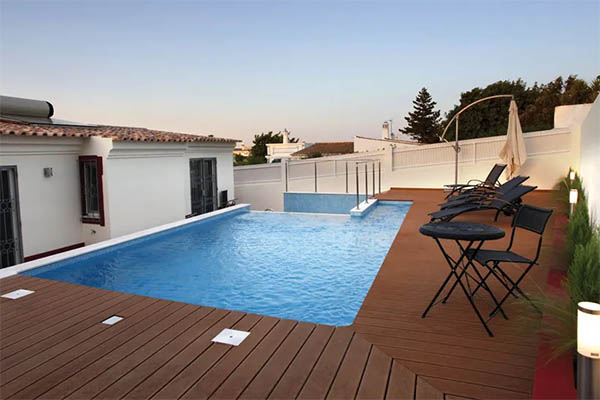
Which Is Better for Poolside Areas?
Poolside decking requires attention to:
- Water exposure
- Drainage
- Surface texture
- Installation
- Ventilation
Hollow vs solid construction alone does not determine water resistance.
A hollow WPC board is not automatically unsuitable around water.
Likewise, a solid board does not eliminate the need for drainage.
The project should consider:
Decking Surface + Profile + Drainage + Support + Installation
together.
Can Water Enter Hollow WPC Decking?
Depending on the profile and exposed board ends, moisture may enter hollow chambers.
This does not automatically mean the decking will fail.
However, installation should avoid conditions where water is unnecessarily trapped.
Important considerations include:
- Drainage
- Correct board orientation
- Suitable edge treatment
- Ventilation
- Manufacturer installation guidance
WPC should be treated as a water-resistant outdoor material, not as a reason to ignore drainage design.
Which Is Better for Rooftop Decking?
Rooftop projects often require careful consideration of:
- Dead load
- Drainage
- Support structure
- Waterproofing layer
- Installation height
Because hollow decking is generally lighter, its lower weight may be useful in some rooftop systems.
However, the entire rooftop deck structure should be evaluated.
Decking weight is only one part of the design.
For raised systems, joists, pedestals and support conditions may be equally important.
Which Is Easier to Handle and Install?
Hollow WPC decking is generally easier to move because it weighs less.
This can help with:
- Manual handling
- Rooftop transport
- Site movement
Solid decking is usually heavier.
However, installation procedures can otherwise be similar depending on the product.
Both may use:
- Joists
- Hidden clips
- Starter clips
- Screws
The exact system depends on the decking profile.
Do Hollow and Solid WPC Decking Use Different Clips?
Not necessarily.
Clip compatibility is usually determined by:
- Side groove geometry
- Board design
- Manufacturer system
A hollow and solid board can sometimes use the same clip if their grooves are compatible.
Other products may require different fasteners.
Always confirm the accessory system for the exact profile.
Do Hollow and Solid WPC Decking Need Different Joist Spacing?
Possibly, but there is no universal answer.
Joist support depends on:
- Board profile
- Dimensions
- Hollow chamber design
- Material
- Application
- Load
Therefore, avoid using one fixed spacing number for every solid or hollow WPC decking product.
Follow product-specific guidance.
Thermal Expansion: Is Solid or Hollow Better?
Both solid and hollow WPC decking contain thermoplastic material and can experience dimensional movement as temperatures change.
Thermal movement depends on factors such as:
- Material formulation
- Board length
- Temperature
- Installation
- Profile
The correct solution is not to assume one profile “does not expand.”
Instead, decking design should provide suitable:
- End clearance
- Side gaps
- Fixing
- Support
according to the selected product.
Which One Gets Hotter in Direct Sunlight?
Surface temperature is not determined simply by whether the board is solid or hollow.
Other factors may have a stronger influence, including:
- Color
- Surface
- Solar exposure
- Air temperature
- Ventilation
Dark decking generally absorbs more solar energy than lighter surfaces.
Therefore, selecting a lighter color may be more relevant to surface heat than choosing between solid and hollow profiles alone.
Does Solid WPC Decking Last Longer?
Not automatically.
Decking service life depends on many factors, including:
- Material quality
- Formulation
- Surface technology
- UV exposure
- Moisture conditions
- Drainage
- Installation
- Support
- Maintenance
A high-quality hollow decking board installed correctly may outperform a poorly manufactured or poorly installed solid board.
Therefore:
Solid profile ≠ guaranteed longer lifespan.
Does Hollow Decking Crack More Easily?
Hollow construction alone does not mean the board will crack.
Cracking risk may be influenced by:
- Material
- Profile design
- Unsupported span
- Installation
- Fastening
- Impact
- Temperature
- Structural conditions
For hollow boards, cross-section and wall design should be considered carefully.
The correct support system is particularly important.
Which Has Better Impact Resistance?
Impact performance depends on the actual product.
Although a solid profile contains more material, buyers should not assume all solid boards have identical impact performance.
If impact resistance is important for a project, request product-specific performance information where available.
Do not replace test information with assumptions based only on cross-section.
Solid vs Hollow WPC Decking and Surface Wear
Surface wear is largely related to:
- Surface material
- Texture
- Capped or uncapped technology
- Traffic
- Maintenance
It is not primarily determined by whether the inside of the board is solid or hollow.
This is why a capped hollow product can sometimes provide better surface performance than an uncapped solid product.
Again, buyers need to distinguish:
internal structure
from:
surface technology.
Which Is Better for B2B Wholesale?
For distributors, the answer depends on the target market.
A distributor may choose hollow decking when customers prioritize:
- Competitive pricing
- Lower weight
- Standard residential projects
Solid decking may be added for:
- Premium product ranges
- Certain commercial projects
- Buyers who prefer heavier profiles
Many distributors benefit from offering more than one profile instead of trying to make one decking board serve every customer.
What Should Importers Compare?
Importers should compare hollow and solid products using the same checklist.
Product Structure
- Board dimensions
- Cross-section
- Hollow or solid
- Wall structure
Weight
- Weight per board or linear length
- Compare equivalent dimensions
Surface
- Traditional or capped
- Texture
- Color
Installation
- Joists
- Clips
- Support guidance
Commercial
- MOQ
- Price
- Packaging
- Loading quantity
This creates a much more useful purchasing comparison than simply asking:
“How much is your solid decking?”
How Does Profile Weight Affect Shipping?
Solid decking generally weighs more.
For international orders, this can influence:
- Total shipment weight
- Container planning
- Handling
However, container utilization also depends on:
- Board dimensions
- Length
- Packaging
- Quantity
A lighter hollow profile may allow a different loading arrangement, but actual container quantities should always be calculated using the selected product.
Hollow vs Solid WPC Decking for Factory-Direct Purchasing
When buying directly from a manufacturer, request actual cross-section photographs for every quoted profile.
Then ask for:
- Dimensions
- Weight
- Surface
- Product code
- Sample
This makes quotation comparison much clearer.
For example, instead of comparing only:
Hollow Decking – $X
and:
Solid Decking – $Y
compare the complete specification behind each price.
Is Solid WPC Decking Worth the Higher Price?
It can be when the selected solid profile provides benefits that matter for the project.
However, paying more for solid decking simply because “solid sounds stronger” may not provide good value.
Consider:
- Application
- Support
- Traffic
- Surface requirement
- Budget
If a suitable hollow profile already meets the project requirements, it may provide better cost efficiency.
When Does Hollow WPC Decking Provide Better Value?
Hollow decking may provide good value when buyers want:
- Lower board weight
- Lower material use
- Competitive initial cost
- Suitable performance for standard outdoor projects
However, “better value” still depends on manufacturing quality.
A poor hollow board is not a good value simply because it is inexpensive.
How to Choose Between Solid and Hollow WPC Decking
Do not begin by asking which one is universally better.
Start with the project.
Step 1: Define the Application
Is it:
- Residential
- Commercial
- Poolside
- Rooftop
- Hospitality
Step 2: Review the Profile
Check:
- Dimensions
- Cross-section
- Weight
- Wall structure
Step 3: Check the Surface
Determine whether the project needs:
- Traditional WPC
- Capped composite decking
Step 4: Review the Support System
Confirm:
- Joists
- Clips
- Product-specific support guidance
Step 5: Compare Cost
Compare equivalent specifications.
Step 6: Request Samples
Inspect the actual product before bulk purchasing.
Solid vs Hollow WPC Decking Buyer Comparison
| Buyer Question | Why It Matters |
|---|---|
| What are the board dimensions? | Defines the basic profile |
| Is the board hollow or solid? | Shows internal structure |
| What does the cross-section look like? | Reveals chamber or solid design |
| What is the board weight? | Helps compare material usage |
| What is the wall structure? | Important for hollow profiles |
| Is it capped or uncapped? | Defines surface technology |
| What surface finish is used? | Affects appearance and use |
| Which joists are recommended? | Important for support |
| Which clips are compatible? | Important for installation |
| What application is recommended? | Prevents incorrect product selection |
| Can I receive samples? | Allows physical comparison |
| What is the complete price? | Helps compare real value |
Common Mistakes When Comparing Solid and Hollow WPC Decking
Mistake 1: Assuming Solid Is Always Better
Solid only describes internal structure.
Mistake 2: Assuming Hollow Means Cheap Quality
A well-designed hollow profile can be suitable for many projects.
Mistake 3: Comparing Only Weight
Weight does not define complete product quality.
Mistake 4: Counting Holes to Judge Quality
Chamber number alone is not enough.
Mistake 5: Assuming Solid Means Capped
Solid and capped describe different product characteristics.
Mistake 6: Ignoring the Support System
Even a solid decking board requires suitable structural support.
Mistake 7: Comparing Different Surface Technologies by Price
Capped and uncapped products should not be treated as identical.
Mistake 8: Using One Joist Spacing for Every Profile
Support requirements should be product-specific.
Mistake 9: Choosing From Photos Only
Cross-sections and physical samples provide more useful information.
Mistake 10: Selecting the Most Expensive Profile Automatically
The highest specification is not always necessary.
Frequently Asked Questions
Is solid WPC decking better than hollow WPC decking?
Not universally. Solid and hollow are different profile structures. The better option depends on board design, application, support, surface technology and project requirements.
Is hollow composite decking strong?
A properly designed hollow composite decking profile can be suitable for many residential and outdoor applications. Actual performance depends on the complete product and support system.
Is solid WPC decking stronger?
Solid decking generally contains more material, but strength and stiffness also depend on dimensions, formulation, profile design and support conditions.
Is solid WPC decking more expensive?
It is often more expensive than a comparable hollow profile because it normally uses more material, but exact pricing depends on the complete specification.
Is hollow WPC decking cheaper?
It is often more economical because internal chambers reduce material usage, although premium hollow products can still cost more than simpler solid boards.
Which is heavier, hollow or solid composite decking?
Comparable solid profiles are generally heavier because they contain more material.
Does heavier WPC decking mean better quality?
No. Weight should be compared together with dimensions, profile, surface technology and manufacturing quality.
Which is better for residential decking?
A suitable hollow profile can provide good value for many residential patios, balconies and gardens. Solid decking can also be used depending on project requirements.
Which is better for commercial decking?
Some commercial projects may benefit from heavier or specific solid profiles, but selection should be based on the exact product and project rather than the word “solid” alone.
Can hollow WPC decking be capped?
Yes. Hollow decking can use a capped or co-extruded surface.
Can solid WPC decking be capped?
Yes. A solid profile can also use capped or co-extrusion technology.
Does hollow WPC decking hold water inside?
Moisture may enter some hollow chambers depending on board-end exposure and installation. Good drainage and correct installation remain important.
Is solid decking more water-resistant than hollow decking?
Not necessarily. Water resistance depends on the material, surface technology and installation rather than internal profile alone.
Does solid WPC decking last longer?
Not automatically. Lifespan depends on product quality, surface, environment, installation, support and maintenance.
Is hollow decking easier to install?
Its lower weight can make handling easier, but installation procedures depend on the specific decking system.
Do hollow and solid boards use the same clips?
Sometimes, if their groove geometry is compatible. Always confirm the accessories for the selected profile.
Does hollow decking need closer joist spacing?
Support requirements depend on the actual board profile and application. There is no universal spacing rule for all hollow decking.
How do I compare hollow WPC decking from different manufacturers?
Compare board dimensions, cross-sections, wall structures, weight, surface technology, samples, installation guidance and price using equivalent specifications.
Should I request physical samples?
Yes. Samples allow buyers to compare actual color, texture, dimensions, profile and cross-section before placing a larger order.
Conclusion
The comparison between solid vs hollow WPC decking should not be reduced to:
Solid = good
and:
Hollow = cheap.
Solid decking generally contains more composite material and weighs more.
Hollow decking uses internal chambers to reduce material and weight.
But neither structure alone determines product quality.
A better comparison considers:
Profile + Dimensions + Cross-Section + Weight + Surface + Support + Application + Cost
For many residential and standard outdoor projects, a well-designed hollow WPC decking profile can provide excellent value.
For selected commercial or project requirements, a solid profile may be a suitable option.
The best choice is therefore not the board with the most material.
It is the board whose complete specification matches the project.
Looking for Solid or Hollow WPC Decking?
Senlai supplies different WPC decking profiles for distributors, contractors and outdoor projects, including hollow, solid, traditional and capped options.
Different surface finishes and colors are available according to product and order requirements.