

Outdoor decking remains exposed to sunlight, rain, temperature changes, dust, and daily foot traffic. Therefore, color stability is an important factor when importers, distributors, contractors, and project buyers compare WPC decking products.
WPC decking color fastness describes how well a decking board retains its original appearance after outdoor exposure. However, it does not mean that the board will never show any color change. Instead, buyers should evaluate how quickly the color changes, whether the change is even, and whether the surface remains attractive throughout normal outdoor use.
This guide explains the main factors that affect color retention, common testing methods, differences between traditional and co-extruded boards, and the checks buyers should complete before placing a bulk order.
What Does WPC Decking Color Fastness Mean?
Color fastness refers to the ability of a material to maintain its color when exposed to environmental conditions. For outdoor WPC decking, the main conditions include ultraviolet radiation, moisture, heat, cleaning chemicals, and long-term surface wear.
A small amount of initial color stabilization may occur after installation. This change usually becomes less noticeable once the surface reaches a more stable condition. In contrast, serious fading may cause boards to look pale, uneven, or significantly different from the approved sample.
Buyers should separate four different color issues:
- Initial color stabilization after outdoor installation
- Long-term fading caused by sunlight and weather
- Color differences between production batches
- Uneven color changes across one installed area
These issues may look similar at first. However, they often have different causes and require different purchasing controls.
Why Does Outdoor WPC Decking Change Color?
Several factors influence WPC decking color stability. Therefore, buyers should not evaluate color performance by looking only at a new sample.
UV Exposure
Ultraviolet radiation can affect pigments, wood fibers, polymers, and surface additives. The level of exposure depends on the project location, installation direction, surrounding buildings, and amount of shade.
For example, decking installed in an open swimming pool area may receive more direct sunlight than decking installed under a covered balcony. As a result, the same product can show different color changes in different applications.
Pigment and Additive Quality
Pigments give WPC decking its visible color. Meanwhile, stabilizers and other additives help protect the material during outdoor exposure.
A consistent formulation supports more stable production. However, changes in pigment quality, dosage, raw material batches, or processing conditions may affect the final appearance. Buyers should therefore confirm that mass production follows the approved formulation and sample.
Wood Fiber and Polymer Formulation
Traditional WPC decking combines wood fiber, polymer, pigments, and additives throughout the board. Because the surface contains both wood and polymer components, changes in the exposed outer layer may affect the visible color.
The type of polymer, wood fiber content, moisture control, mixing quality, and extrusion temperature can all influence the finished surface. Therefore, two boards with a similar color name may perform differently outdoors.
Surface Structure
Surface treatment also affects how people see color changes. Deep embossed surfaces create shadows and stronger visual texture, while smooth or lightly brushed surfaces reflect light differently.
In addition, mixed-color and dual-color surfaces can hide small visual changes better than a completely uniform surface. Buyers comparing appearance options can review the WPC decking color selection guide before approving a project color.
Climate and Installation Conditions
High-temperature regions, coastal locations, rainy climates, and areas with strong seasonal changes create different exposure conditions.
For example, strong sunlight may increase visible fading, while moisture and dirt can make a surface appear darker. Poor drainage may also leave water marks or stains that customers mistakenly identify as color failure.
How Is WPC Decking Color Fastness Tested?
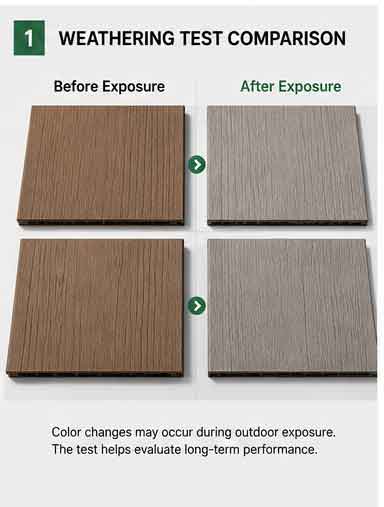
A useful test should show how the material reacts under controlled or documented conditions. However, a simple statement such as “UV resistant” does not provide enough information for a purchasing decision.
Accelerated Weathering Tests
An accelerated weathering chamber can expose samples to controlled cycles of light, heat, and moisture. The test helps manufacturers and buyers compare material performance without waiting for several years of natural exposure.
When reviewing this type of test, buyers should confirm:
- The testing method
- The total exposure duration
- The light and moisture cycle
- The testing temperature
- The sample formulation
- The decking surface type
- The condition before and after testing
Test duration alone does not tell the full story. Two reports cannot be compared fairly when they use different methods, temperatures, light sources, or sample structures.
Outdoor Exposure Tests
Natural outdoor exposure places samples in a real environment for a recorded period. This method reflects actual sunlight, rain, dust, and temperature changes. However, it takes longer and results depend heavily on the test location.
Therefore, buyers should check where the samples were exposed, how long they remained outdoors, and whether all samples received similar sunlight and moisture.
Instrumental Color Measurement
A color measurement instrument can compare a sample before and after exposure. The result may include a color difference value, often shown as ΔE.
A lower change generally indicates that the two measured colors remain closer to each other. However, buyers should not compare isolated values without checking the test method, equipment, sample position, and exposure conditions.
Visual Sample Comparison
Visual comparison is still useful, especially when buyers evaluate the product under natural light. Nevertheless, lighting conditions, camera settings, screen differences, and personal judgment can change how the color appears.
For this reason, buyers should combine visual checks with clear sample records and available test information.
Traditional vs Co-Extruded WPC Decking Color Stability
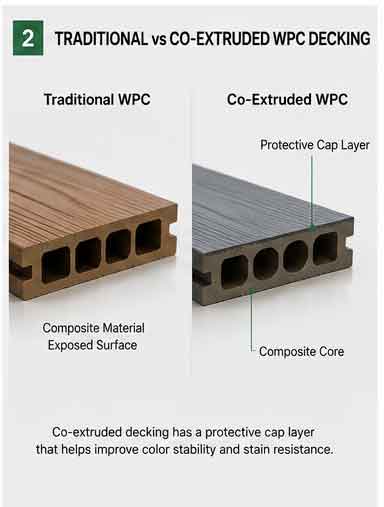
Traditional and co-extruded WPC decking use different surface structures. Consequently, their outdoor color performance may also differ.
Traditional WPC Decking
Traditional WPC decking uses the same composite material throughout the profile. Its wood-plastic surface remains directly exposed to outdoor conditions.
This option usually provides a more economical solution for residential decks, garden paths, terraces, and general outdoor flooring. However, its color performance depends strongly on the full material formulation, pigment system, production control, and project environment.
Co-Extruded WPC Decking
Co-extruded decking includes a protective outer layer around the composite core. This surface layer can improve resistance to stains, moisture, and outdoor weathering when the product uses a suitable formulation.
As a result, co-extruded decking often provides better color retention for commercial areas, pool surroundings, hotels, high-sun locations, and projects with higher appearance requirements.
Buyers can compare co-extruded WPC decking color options before deciding whether a single-color, mixed-color, or dual-color surface better suits the project.
The following table provides a general comparison between traditional and co-extruded WPC decking. Actual performance still depends on the formulation, manufacturing process, project climate and maintenance conditions.
Comparison Table
| Comparison Item | Traditional WPC Decking | Co-Extruded WPC Decking |
|---|---|---|
| Surface Structure | Composite material is directly exposed at the surface. | The composite core is covered by a protective outer layer. |
| Color Stability | Depends on the complete material formulation and pigment system. | Usually provides stronger surface protection and color retention. |
| Stain Resistance | Standard stain resistance with regular cleaning required. | Generally offers better resistance to stains and moisture. |
| Surface Options | Brushed, grooved and embossed surface options. | Wood grain, mixed-color and dual-color surface options. |
| Project Budget | More economical for price-sensitive projects. | Higher initial cost due to the protective cap layer. |
| Common Applications | Residential decks, garden paths and standard outdoor projects. | Commercial spaces, pool areas and appearance-sensitive projects. |
Although co-extruded decking usually offers stronger surface protection, buyers should not assume that every capped board performs equally. The cap formulation, coverage, adhesion, pigment quality and production control still affect long-term performance.
Although co-extruded decking usually offers stronger surface protection, buyers should not assume that every capped board performs equally. The cap formulation, coverage, adhesion, pigment quality, and production control still matter.
How Climate Affects WPC Decking Color
Project location should influence material and color selection. Therefore, buyers should give the supplier accurate information about the destination country and application.
High-UV and Hot Climates
Open areas in hot and sunny regions receive strong UV exposure. In these locations, buyers should pay special attention to pigment stability, surface protection, and approved weathering information.
Lighter colors may also absorb less visible heat than very dark colors. However, final surface temperature depends on more than color alone, including sunlight, airflow, board structure, and installation conditions.
Coastal and Humid Areas
Coastal decks face moisture, salt, dirt, and strong sunlight. These conditions may not only affect the material but also change how the surface looks.
Good drainage, suitable expansion gaps, and regular cleaning help maintain a more consistent appearance. In addition, co-extruded surfaces may be easier to clean when the project faces frequent moisture and staining.
Rainy and Shaded Areas
Shaded decking may receive less direct sunlight, but moisture, dust, algae, and water marks can change the visible surface color. Therefore, customers should not treat every darkened area as material fading.
Cleaning a small test area can help determine whether the issue comes from surface contamination or a permanent color change.
Cold and Seasonal Climates
Snow, freezing temperatures, rain, and seasonal sunlight create repeated environmental changes. Buyers should therefore consider overall weather resistance instead of checking only UV exposure.
How Should Buyers Compare WPC Decking Samples?
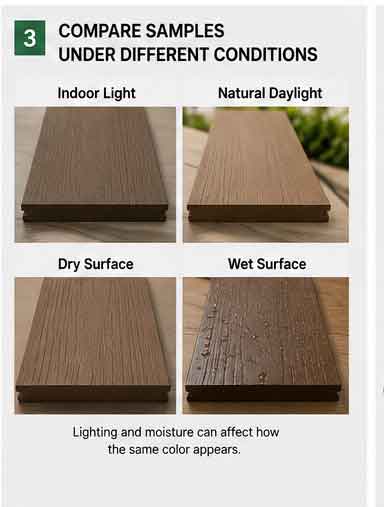
A small sample helps buyers review color, texture, profile, and surface quality. However, one new sample cannot fully demonstrate long-term outdoor performance.
Before approving a color, buyers should complete the following checks.
Confirm the Exact Product Structure
Check whether the sample is traditional WPC, 3D embossed WPC, or co-extruded WPC. In addition, confirm whether the mass order will use the same profile, surface, and formulation.
Check the Sample Under Natural Light
Indoor lighting can make grey, teak, coffee, and brown boards look different. Therefore, place the samples outdoors and compare them in daylight.
Compare Dry and Wet Surfaces
Water can temporarily deepen the visible color. Buyers should compare both dry and wet samples, especially for pool decks, coastal projects, and rainy markets.
Review More Than One Board
One board cannot represent the complete production batch. Ask for several pieces when color consistency is important.
Record the Approved Sample
Label the sample with the color code, profile, surface type, approval date, and project name. Both buyer and supplier should retain a reference sample.
Confirm Production and Sample Consistency
The supplier should produce the order according to the approved sample and confirmed specifications. Buyers should also clarify the acceptable visual color range before production.
Keep Future Replacement Requirements in Mind
Replacement boards produced much later may not match an older installation exactly. Therefore, large projects may order a reasonable number of spare boards together with the main shipment.
How Can Buyers Reduce Batch Color Differences?
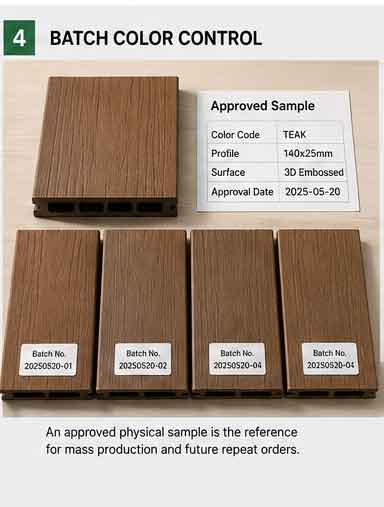
Batch color control is important for distributors, contractors, and phased construction projects. Even when products use the same color name, production timing and raw material variation may create visible differences.
The following steps can reduce risk:
- Approve a physical production sample before mass production
- Use one confirmed color code and formulation
- Produce one project order within the same planned batch when possible
- Record raw material and pigment batch information
- Compare the first production boards with the approved sample
- Avoid mixing boards from unrelated production batches
- Retain signed or labeled samples for future reference
- Reconfirm color before placing a repeat order
- Order spare boards with the original shipment when practical
For more detail, buyers can review how to customize WPC decking colors without batch differences.
What Should Buyers Ask a WPC Decking Supplier?
Before placing a bulk order, importers and project buyers can ask the following questions:
- What type of pigment and color control process do you use?
- Do you have available UV or weathering test information?
- What test method and exposure duration were used?
- Does the test apply to the same decking structure and formulation?
- Can you provide samples from current production?
- How do you compare mass production with the approved sample?
- How do you control color differences between batches?
- Can the project order be produced within one planned batch?
- What color changes may occur during initial outdoor exposure?
- Which decking type do you recommend for the project climate?
- Can spare boards be supplied with the main order?
- What information is required for a repeat order?
Clear answers help buyers compare suppliers on more than price. They also reduce disputes after production and delivery.
Frequently Asked Questions
Does All WPC Decking Fade?
Most outdoor materials can show some appearance change after long-term weather exposure. However, the degree and speed of change depend on the product structure, formulation, pigments, surface protection, climate, and maintenance.
What Is Initial Color Stabilization?
Initial color stabilization refers to a small appearance change that may occur after the board begins outdoor exposure. It differs from severe or uneven long-term fading.
Does Co-Extruded Decking Have Better Color Fastness?
Co-extruded decking usually offers stronger surface protection because it has an outer protective layer. Nevertheless, buyers should still review the cap quality, product formulation, sample consistency, and available test information.
Which WPC Decking Color Fades the Least?
There is no single color that performs best in every product and climate. Pigment quality, formulation, surface structure, UV exposure, and maintenance often matter more than the color name alone.
Are Dark WPC Decking Colors More Difficult to Maintain?
Dark surfaces may show dust, scratches, water marks, or contrast changes more clearly in some environments. However, actual performance depends on the product and project conditions.
Can Photos Be Used to Approve a WPC Decking Color?
Photos can support initial selection, but they should not replace a physical sample. Lighting, camera settings, editing, and screen differences can change the visible color.
How Can Importers Check Color Consistency Before Shipment?
Importers can ask the supplier to compare random production boards with the approved sample under consistent lighting. They can also request production photos, color records, and pre-shipment sample checks.
Can Replacement Boards Match an Existing Deck Exactly?
An exact match may be difficult after long outdoor exposure or when the replacement comes from a different production batch. Therefore, buyers should keep the original product code and consider ordering spare boards with the main project.
You can also compare our WPC decking series, including straight grain, 3D embossed, and co-extruded surface options.
Final Buying Recommendation
WPC decking color fastness should not be judged by a color name, one product photo, or a general “UV resistant” statement. Instead, buyers should review the material structure, exposure conditions, testing information, physical samples, and batch control process.
Traditional WPC decking can provide a practical and economical solution for many outdoor projects. Meanwhile, co-extruded decking may provide stronger surface protection for high-UV, commercial, poolside, and appearance-sensitive applications.
Before ordering, compare the WPC decking product range, confirm the project climate, approve physical samples, and record the exact profile, surface, color code, and production requirements.
Need Help Comparing WPC Decking Colors?
SenlaiWPC supplies traditional, 3D embossed, and co-extruded WPC decking for wholesale and project orders.
To request WPC decking samples, provide the project country, application, preferred color, decking type, estimated quantity, and required delivery time. Our team can help compare suitable profiles and prepare product information for your evaluation.


