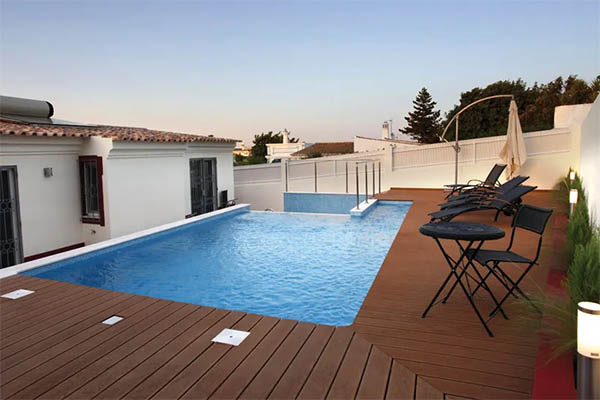
WPC and PVC decking are two common outdoor decking materials, each with its own advantages and disadvantages. They are widely used for outdoor ground covering such as balconies, patios, terraces, and swimming pool surroundings. Below is a detailed comparison:
1. Material Composition
WPC (Wood-Plastic Composite Decking):
- Made from a blend of wood fibers (such as wood flour or bamboo fiber) and plastics (such as polyethylene (PE) or polypropylene (PP)).
- Combines the appearance of wood with the durability of plastic.
PVC Decking:
- Made from polyvinyl chloride (PVC) plastic, typically without any wood components.
- Pure plastic material with excellent water and corrosion resistance.
2. Appearance and Design
WPC Decking:
- Features a wood-like appearance with natural grain and color.
- Can be manufactured with different surface textures, such as straight grain or embossed patterns.
PVC Decking:
- Has a relatively smooth plastic surface.
- Some high-end PVC decking can imitate wood grain, but the natural texture is generally inferior to WPC.
- Available in a wide range of colors and designs, though the visual effect is usually less natural.
3. Durability
WPC Decking:
- Due to its wood content, WPC decking is relatively less resistant to extreme weather and UV exposure.
- May swell or crack in humid environments.
- With proper care, WPC decking is durable, but slightly less so than PVC.
PVC Decking:
- Excellent water resistance, ideal for humid environments.
- Resistant to rotting, cracking, and swelling.
- Strong UV resistance, suitable for long-term outdoor use, even under direct sunlight.
4. Maintenance
WPC Decking:
- Requires regular cleaning and maintenance.
- Wood components may absorb moisture, so keeping the surface dry is important.
PVC Decking:
- Very low maintenance.
- Not easily affected by water, dust, or stains.
- Daily cleaning is sufficient; no special maintenance is required.
5. Environmental Impact
WPC Decking:
- More environmentally friendly than PVC because it contains renewable wood components.
- Some brands use recycled wood and plastic, improving environmental performance.
- However, plastic content still makes complete recycling challenging.
PVC Decking:
- Primarily made from petroleum-based materials, resulting in higher carbon emissions during production.
- Low-quality PVC decking may contain harmful substances such as plasticizers, posing environmental concerns.
6. Price
WPC Decking:
- Generally more expensive than PVC decking.
- Higher cost is due to combined wood and plastic materials and manufacturing complexity.
PVC Decking:
- More economical.
- Suitable for projects with limited budgets.
7. Comfort
WPC Decking:
- Feels warmer and softer underfoot due to its wood content.
- Closer to the feel of natural wood.
PVC Decking:
- Has a harder surface and feels colder underfoot.
- Comfort can be improved through special processing, but it is generally less warm than WPC.
8. Installation and Processing
WPC Decking:
- Easy to process and install.
- Commonly uses click-lock or groove systems for quick installation.
PVC Decking:
- Also easy to install.
- Click-lock systems make it suitable for DIY projects.
Summary
- WPC decking is ideal for users who value natural wood aesthetics, comfort, and environmental considerations, and who are willing to perform regular maintenance.
- PVC decking is better suited for budget-conscious users who prioritize waterproofing and durability, especially in harsh or high-humidity outdoor environments.
Both materials have their strengths, and the final choice should be based on budget, application environment, and personal preferences.