Plastic decking can be a better choice than wood when low maintenance, moisture resistance and consistent appearance are important. However, natural wood may still be preferred when buyers want authentic timber grain and are willing to carry out regular maintenance.
The answer therefore depends on the project rather than one material being better in every situation.
Another important point is that the term plastic decking can describe several different products.
It may refer to pure plastic lumber, PVC decking or wood plastic composite decking. These materials are not exactly the same.
For many outdoor flooring projects, buyers are actually comparing traditional wood with WPC composite decking, which combines wood fiber and thermoplastic materials.
This guide compares plastic decking vs wood in terms of material, appearance, maintenance, moisture resistance, installation, cost and outdoor applications.
What Is Plastic Decking?
Plastic decking is a general term used for outdoor decking boards that contain plastic materials.
Depending on the product, this may include:
• Pure plastic lumber
• Recycled plastic decking
• PVC decking
• Wood plastic composite decking
• WPC composite decking
These products have different formulations.
Pure plastic lumber is generally made mainly from plastic, while WPC decking combines wood fiber with thermoplastic materials and additives.
For this reason, buyers should check the material specification rather than assuming that all plastic decking products perform in exactly the same way.
In outdoor flooring applications, WPC decking is especially common because it combines plastic with wood fiber and can be manufactured with wood grain surface finishes.
What Is Wood Decking?
Wood decking is made from natural timber boards.
Different markets use different wood species for outdoor decking.
Depending on the project, these may include softwoods, hardwoods or treated timber.
Natural wood is popular because of its authentic appearance.
Each board has natural differences in:
• Grain
• Color
• Knots
• Texture
• Pattern
However, wood is an organic material.
Exposure to rain, sunlight, humidity and temperature changes can affect its appearance and condition over time.
For this reason, natural wood decking generally requires more regular maintenance than plastic or composite decking.
Plastic Decking vs Wood at a Glance
| Feature | Plastic or Composite Decking | Natural Wood Decking |
|---|---|---|
| Main material | Plastic or wood fiber plus plastic | Natural timber |
| Appearance | Consistent, multiple finishes | Authentic natural wood |
| Maintenance | Low | Higher |
| Painting or staining | Usually not required | Often required |
| Moisture resistance | Generally high | Depends on wood and treatment |
| Insect resistance | Generally good | Depends on species and treatment |
| Color consistency | More consistent | Natural variation |
| Surface options | Multiple manufactured finishes | Natural wood grain |
| Initial cost | Depends on product | Depends on wood species |
| Long term maintenance cost | Usually lower | Can be higher |
| Outdoor use | Yes | Yes |
| Regular treatment | Limited | Often required |
The best material depends on the application, budget and maintenance expectations.
1. Maintenance
Maintenance is one of the biggest differences between plastic decking and wood.
Plastic and Composite Decking
WPC and plastic decking normally require relatively simple maintenance.
Typical maintenance includes:
• Removing leaves
• Washing dirt from the surface
• Cleaning stains
• Keeping drainage gaps clear
• Checking clips and substructure periodically
Most composite decking does not need regular painting, staining or sealing.
This can be useful for commercial projects, hotels, resorts, balconies and residential outdoor spaces where frequent maintenance is inconvenient.
Wood Decking
Natural wood generally requires more attention.
Depending on the timber species and environment, maintenance may include:
• Cleaning
• Sanding
• Staining
• Painting
• Sealing
• Replacing damaged boards
• Applying protective treatments
Maintenance requirements vary significantly between wood species.
However, buyers who choose wood should normally expect more ongoing care than with WPC composite decking.
2. Water and Moisture Resistance
Outdoor decking is regularly exposed to rain and humidity.
This makes moisture performance an important consideration.
Plastic Decking
Plastic based materials do not react to water in the same way as untreated timber.
WPC composite decking also combines wood fiber with plastic materials, helping improve moisture resistance compared with many natural wood products.
This makes composite decking popular for:
• Gardens
• Balconies
• Terraces
• Pool surroundings
• Humid outdoor areas
However, water resistance does not mean that drainage can be ignored.
Correct board spacing, ventilation and drainage are still necessary.
Wood Decking
Natural wood can absorb moisture.
Repeated wet and dry cycles may contribute to:
• Swelling
• Shrinkage
• Cracking
• Warping
• Surface changes
The extent depends on the wood species, treatment and installation environment.
Proper sealing and maintenance can help protect wood decking.
3. Appearance
Natural wood and composite decking offer very different visual characteristics.
Wood Decking Appearance
Natural timber has genuine wood grain.
No two boards are exactly identical.
For buyers who value authentic timber appearance, natural wood remains difficult to reproduce perfectly.
Wood also develops its own appearance as it ages.
Some buyers appreciate this natural change.
Plastic and Composite Decking Appearance
Modern composite decking can imitate wood quite closely.
WPC manufacturers can produce:
• Straight grain
• Wood grain embossing
• 3D embossed surfaces
• Brushed finishes
• Co extrusion surfaces
• Multiple colors
• Two tone finishes
The advantage is consistency.
For commercial projects or large areas, buyers may prefer boards with a more uniform color and surface.
Composite decking therefore provides a different visual advantage from natural wood.
Wood offers authenticity.
Composite decking offers consistency and more controlled production.
4. Color Options
Wood color is determined largely by the timber species and treatment.
Stains can change the final appearance, but this creates additional maintenance.
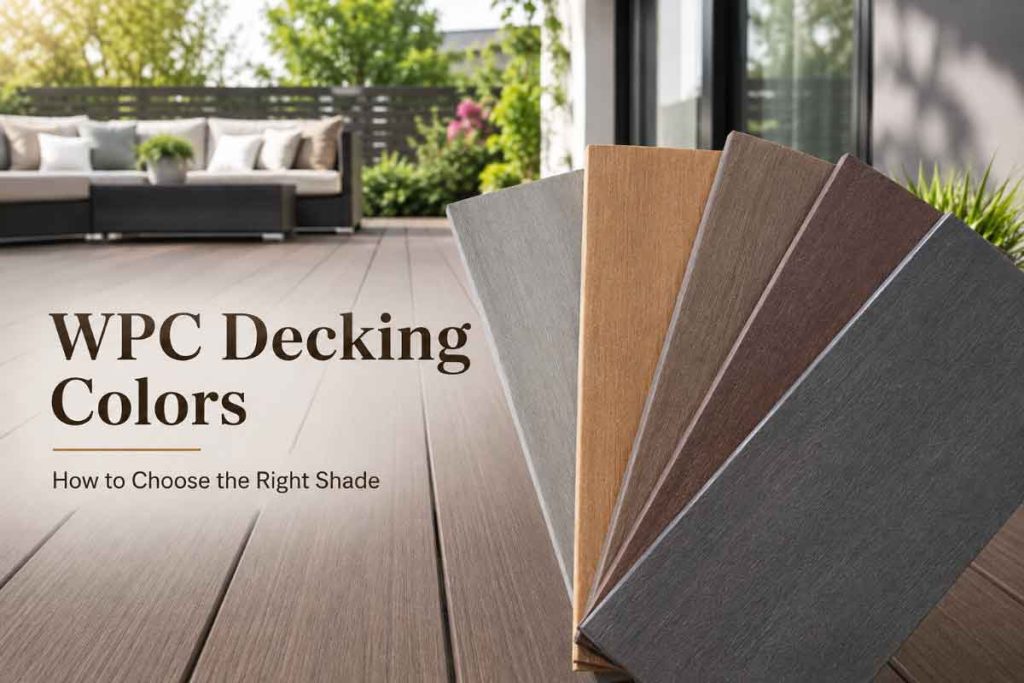
Composite decking can be manufactured in a wide range of colors.
Common options may include:
• Teak
• Coffee
• Brown
• Light grey
• Silver grey
• Charcoal
Manufacturers may also support customized colors for larger orders.
This can be useful for distributors or project buyers who need decking to match:
• Buildings
• Walls
• Fences
• Outdoor furniture
• Landscape design
However, buyers should confirm actual samples because screen colors do not always match physical products.
5. UV Exposure and Color Change
Both wood and manufactured decking materials can change when exposed to sunlight.
Natural timber may gradually fade, grey or change tone depending on the species and treatment.
Composite decking may also experience some color change, particularly during early outdoor exposure.
Modern WPC products commonly include UV related additives, while co extrusion decking includes an outer protective layer.
However, no outdoor material should be described as completely unaffected by UV exposure.
When color stability is important, buyers should ask the manufacturer about the specific product and available test information.
6. Insects and Termites
Natural wood can be vulnerable to insects depending on the species, treatment and local environment.
Termites and other wood damaging insects can become a concern in some regions.
Plastic and WPC decking do not behave like untreated timber.
Because the material is manufactured using plastic and additives, composite decking generally offers good resistance to termite related damage.
This is one reason WPC decking is often considered in warm and humid markets.
However, the complete installation system should still be inspected and maintained.
7. Splinters and Surface Comfort
Natural wood can develop splinters as it ages, particularly if the surface becomes weathered.
Regular sanding and maintenance may reduce this problem.
Composite decking does not splinter in the same way as conventional timber.
This can be useful for:
• Barefoot areas
• Balconies
• Pool surroundings
• Garden decks
• Residential patios
The actual surface feel still depends on the decking profile and finish.
8. Slip Resistance
Slip resistance is important for outdoor flooring.
Both wood and composite decking can become slippery when wet, particularly if dirt, algae or other contaminants accumulate.
Composite decking can be manufactured with textured surfaces such as:
• Grooves
• Straight grain
• Embossed wood grain
• Brushed textures
These surfaces can provide additional grip.
However, slip performance should not be judged only from appearance.
For commercial or poolside projects, buyers should request relevant product information or test data when slip resistance is an important requirement.
9. Expansion and Contraction
All outdoor decking materials move when environmental conditions change.
However, wood and composite materials behave differently.
Wood Decking
Wood responds strongly to changes in moisture.
Boards may expand when they absorb moisture and contract when they dry.
Composite Decking
WPC decking responds to temperature changes.
The plastic component expands and contracts as temperatures rise and fall.
For this reason, correct installation gaps are essential.
Installers should follow the manufacturer’s recommendations for:
• Side gaps
• End gaps
• Joist spacing
• Fastening
• Distance from walls
• Ventilation
Incorrect installation can create problems regardless of decking quality.
10. Installation
Both wood and composite decking require a stable substructure.
However, the fastening methods can differ.
Wood Decking Installation
Wood boards are often fixed directly with:
• Screws
• Nails
• Specialized hidden fasteners
Installation depends on the timber type and deck design.
Composite Decking Installation
WPC decking commonly uses a hidden clip system.
A complete composite decking system may include:
• Decking boards
• WPC joists
• Aluminum joists
• Starter clips
• Intermediate clips
• Stainless steel screws
• Edge trims
• Fascia boards
Hidden clips create a cleaner appearance because screws are not visible on the main decking surface.
For wholesale buyers, comparing the complete system is important because accessory costs can affect the total project price.
11. Hollow vs Solid Decking
Another difference between WPC decking and traditional wood is profile design.
Wood boards are naturally solid.
Composite decking can be manufactured as either hollow or solid profiles.
Hollow WPC Decking
Hollow decking contains internal chambers.
Advantages can include:
• Lower product weight
• Reduced material usage
• Easier handling
• Efficient transportation
Solid WPC Decking
Solid boards contain more material throughout the cross section.
They are heavier and may be selected for projects where a solid profile is preferred.
Neither type is automatically better.
The correct profile depends on:
• Project requirements
• Joist spacing
• Installation environment
• Board dimensions
• Budget
12. Plastic Decking vs Wood Around a Pool
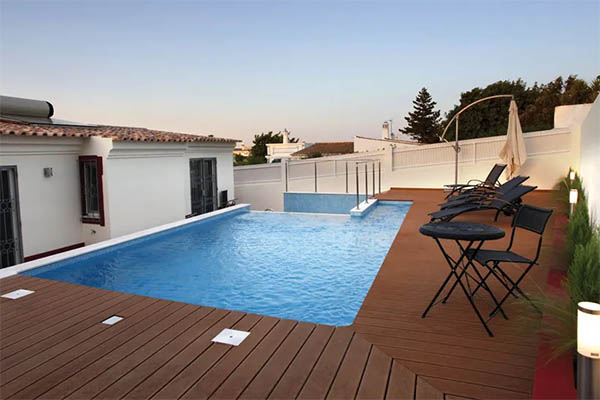
Poolside decking needs special consideration because it is regularly exposed to water and sunlight.
Composite decking is commonly considered for pool areas because of its moisture resistance and low maintenance.
However, buyers should consider several factors.
Surface Grip
Choose an appropriate textured surface.
Drainage
Water should be able to drain quickly from the deck.
Ventilation
The substructure should have sufficient airflow.
Color
Dark colors may become hotter under direct sunlight.
Fasteners
Use accessories suitable for outdoor and humid conditions.
Natural wood can also be used around pools, but maintenance requirements may be higher.
13. Which Material Is More Durable?
There is no single lifespan that applies to all plastic decking or all wood decking.
Durability depends on many factors.
For composite decking, these include:
• Material formulation
• Manufacturing quality
• Board structure
• Installation
• UV exposure
• Climate
• Maintenance
For natural wood, durability depends on:
• Wood species
• Treatment
• Moisture exposure
• Insects
• Installation
• Maintenance
A high quality wood deck that is properly maintained can perform well for many years.
Likewise, a properly manufactured and installed WPC deck can provide long term outdoor service.
Buyers should therefore compare actual product specifications rather than relying on generic lifespan claims.
14. Plastic Decking vs Wood Cost
Cost is another common reason people compare these two materials.
However, it is important to separate initial cost from long term cost.
Initial Cost
Wood prices vary significantly by species.
Some softwood decking can have a lower initial price.
Premium hardwood can be much more expensive.
Composite decking prices also vary depending on:
• Hollow or solid structure
• Board weight
• Surface finish
• Co extrusion technology
• Color
• Order quantity
• Manufacturer
• Accessories
Long Term Cost
Wood may require additional expenses over time for:
• Staining
• Painting
• Sealing
• Sanding
• Repairs
• Replacement boards
Composite decking generally requires less regular treatment.
For this reason, buyers should compare the total cost over the expected service period rather than simply comparing the price per square meter.
15. Which Is Better for Commercial Projects?
Commercial projects often have different requirements from residential projects.
Hotels, resorts, restaurants and public outdoor areas may prioritize:
• Low maintenance
• Consistent appearance
• Replacement availability
• Installation efficiency
• Easy cleaning
• Stable supply
• Bulk purchasing
Composite decking can be attractive for these projects because boards can be manufactured consistently in large quantities.
A manufacturer may also provide matching:
• Joists
• Clips
• Screws
• Edge trims
• Fascia boards
However, commercial buyers should request technical specifications and confirm project requirements before ordering.
16. Is Plastic Decking Better for Wholesale Buyers?
For distributors, the comparison is not only about material performance.
Wholesale buyers should also consider:
• Product range
• MOQ
• Container loading
• Packaging
• Color consistency
• Replacement supply
• Sample availability
• OEM options
• Accessories
• Production capacity
Composite decking can be particularly suitable for distributors because manufacturers can provide multiple profiles and colors within a consistent product system.
However, buyers should avoid stocking too many models initially.
A smaller selection of popular colors and profiles can make inventory easier to manage.
Plastic Decking vs Wood: Advantages and Disadvantages
Advantages of Plastic and Composite Decking
• Low maintenance
• Good moisture resistance
• No regular staining required
• Multiple color options
• Consistent appearance
• Multiple surface textures
• Hollow and solid profiles available
• Hidden clip installation systems
• Good resistance to insects
Disadvantages of Plastic and Composite Decking
• Does not perfectly reproduce natural timber
• Thermal expansion must be considered
• Dark colors may become warm in strong sunlight
• Product quality varies between manufacturers
• Initial cost can be higher than some basic timber options
Advantages of Wood Decking
• Authentic natural wood grain
• Traditional appearance
• Wide range of timber species
• Can be refinished
• Familiar material for installers
Disadvantages of Wood Decking
• Requires more maintenance
• Can absorb moisture
• May crack or splinter
• May require staining and sealing
• Some species can be affected by insects
• Appearance changes naturally over time
Is Plastic Decking Better Than Wood?
For many outdoor projects, plastic or composite decking can be a better choice when the priorities are:
• Low maintenance
• Moisture resistance
• Consistent appearance
• Easy cleaning
• Multiple color options
• Wood grain surface choices
Natural wood may be the better choice when the priorities are:
• Authentic timber appearance
• Natural material
• Traditional design
• Ability to refinish the surface
Neither option is universally superior.
The best choice depends on the project.
What Should Buyers Check Before Choosing?
Before purchasing wood or composite decking, compare the following factors.
1. Project Environment
Consider rainfall, humidity, sunlight and temperature.
2. Maintenance Expectations
Decide how much regular maintenance is acceptable.
3. Appearance
Choose between authentic timber variation and consistent manufactured wood grain.
4. Budget
Compare both initial and long term costs.
5. Installation System
Confirm the required joists, fasteners and spacing.
6. Surface Requirements
Consider slip resistance and texture.
7. Product Structure
For WPC decking, compare hollow and solid profiles.
8. Samples
Physical samples make it easier to evaluate:
• Color
• Surface texture
• Cross section
• Weight
• Grain depth
• Overall appearance
For wholesale and commercial orders, samples are especially useful before mass production.
Frequently Asked Questions
1. Is plastic decking better than wood?
Plastic or composite decking can be better than wood when low maintenance, moisture resistance and consistent appearance are important. Wood may be better for buyers who prioritize authentic natural timber.
2. Does plastic decking last longer than wood?
There is no universal answer. Service life depends on product quality, installation, climate and maintenance. Different wood species and composite products can perform very differently.
3. Is composite decking more expensive than wood?
It depends on the wood species and composite decking type. Some basic timber products may have a lower initial cost, while premium wood can cost more. Long term maintenance should also be included in the comparison.
4. Does composite decking require maintenance?
Yes, but it generally requires less maintenance than natural wood. Regular cleaning and inspection are still recommended.
5. Is plastic decking waterproof?
Plastic based decking generally offers high moisture resistance. WPC composite decking also performs well in outdoor conditions, but correct drainage, ventilation and installation remain necessary.
6. Does composite decking look like real wood?
Modern WPC decking can use embossed wood grain, 3D textures, brushed surfaces and co extrusion finishes to create a natural wood style appearance. However, it is still a manufactured material and will not be identical to natural timber.
7. Is composite decking good for pool areas?
Composite decking can be suitable for poolside projects when the selected board has an appropriate surface and the deck is installed with proper drainage and ventilation.
8. Which is easier to maintain, wood or composite decking?
Composite decking is generally easier to maintain because it usually does not require regular painting, staining or sealing.
Conclusion
So, is plastic decking better than wood?
For projects where low maintenance, moisture resistance, consistent colors and multiple surface options are important, plastic or WPC composite decking can offer clear advantages.
Natural wood still has its own appeal.
It provides authentic grain, natural variation and a traditional appearance that manufactured materials cannot reproduce exactly.
The right choice therefore depends on what matters most to the project.
For residential users, maintenance and appearance may be the main factors.
For contractors, distributors and commercial buyers, product consistency, installation systems, packaging, availability and long term maintenance can be equally important.
When comparing plastic decking vs wood, avoid choosing based on price alone.
Compare the complete decking system, installation requirements, expected maintenance and actual product samples before making the final decision.