When you’re in the market for WPC (Wood-Plastic Composite) boards, one of the biggest concerns most buyers have is ending up with low-quality products that don’t live up to their promises. It’s not uncommon to find two WPC boards that look almost identical at first glance, but their prices can vary drastically—sometimes by double or more. The reason behind this big price gap is actually pretty straightforward: one board is made with high-quality new materials, while the other is produced using recycled waste plastics and inferior wood powder.
In this guide, we’re going to walk you through exactly how to tell these two types of WPC apart, no fancy tools required. All you need is your eyes to look closely, your hands to feel the weight and texture, and your nose to pick up on any odd smells—and you’ll be able to spot the difference in no time.
Part 1: Quick Identification Methods
(No Tools Needed)
You don’t need any professional equipment or technical knowledge to check the quality of WPC boards. In fact, you can identify whether a WPC board is new or recycled in less than 30 seconds if you follow these simple, step-by-step checks we’re about to share.
1. Check Color and Surface
The surface of a WPC board is the first thing you should look at because it gives away a lot about the quality of the materials used to make it. A quick glance at the surface can tell you more than you might think.
New WPC
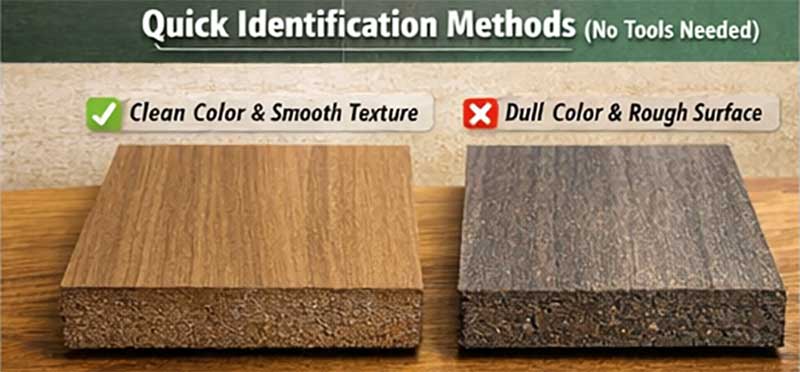
- The color is clean, consistent, and even all across the surface, with no random splotches or faded areas.
- The texture feels natural, almost like real wood, with a smooth finish that isn’t rough or grainy.
- The wood grain is clear and easy to see, with a three-dimensional look that adds to its natural appearance.
- There are no black spots, white specks, or other impurities visible on the surface—just a clean, uniform finish.
- It has a slight, natural shine that comes from the high-quality virgin resin used in its production, not from a cheap coat of paint.
Recycled WPC
- The color tends to be dark, dull, and lifeless, lacking the natural vibrancy of new WPC boards.
- The surface looks cloudy or hazy, as if it’s covered in a thin layer of dust or residue that won’t wipe off.
- You can easily spot black or white spots scattered across the surface—these are leftover bits of waste plastic or low-quality wood powder that didn’t mix properly.
- The wood grain is either unclear, faded, or completely missing, making the board look flat and artificial.
- There are often uneven color patches, since recycled materials are hard to mix uniformly, leading to splotches of lighter and darker areas.
2. Check the Cross-Section
(Most Important Step)
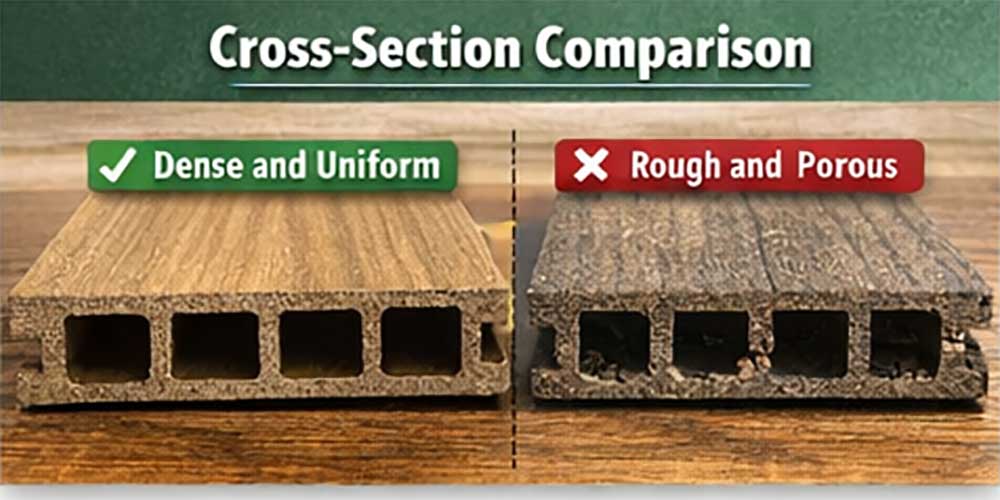
While some unethical sellers might polish or paint recycled WPC boards to make their surface look like new, they can’t hide the truth about what’s inside. The cross-section of a WPC board is the most reliable way to tell if it’s made with new or recycled materials, because it shows the actual internal structure.
New WPC
- The internal structure is dense, smooth, and uniform, with no gaps or empty spaces between the wood powder and plastic.
- There are no holes, small particles, or impurities visible—just a solid, consistent texture throughout.
- The color of the cross-section is almost the same as the surface, which means the materials were mixed evenly during production.
- The wood powder and plastic are fully integrated, creating a strong, cohesive structure that feels solid to the touch.
Recycled WPC
- The internal structure is rough, loose, and uneven, with visible gaps and empty spaces between the materials.
- You can see small holes, hard particles, and even bits of foreign debris (like plastic fragments) scattered throughout the cross-section.
- Black or white impurities are clearly visible inside, which are leftover from the recycled waste materials used to make the board.
- It may have layers or clumps where the materials didn’t mix properly, creating weak spots in the board’s structure.
- The surface is so soft that you can easily scratch it with your fingernail, leaving a visible mark or even scraping off small pieces.
3. Check Weight and Smell
Once you’ve checked the surface and cross-section, two more quick checks—weight and smell—can confirm what you’ve already noticed. These are simple but effective ways to double-check the quality of a WPC board.
Weight
- New WPC boards feel heavy and solid when you pick them up, even if they’re small in size. This is because they have a dense internal structure and are made with high-quality materials that add weight.
- Recycled WPC boards, on the other hand, feel light and weak. Their loose, porous structure means they’re less dense, so even a large board will feel surprisingly light compared to a new one of the same size.
Smell
- New WPC boards have a light, natural smell—something like a combination of wood and mild plastic. It’s not strong or unpleasant, and it fades quickly if you leave the board out in the open.
- Recycled WPC boards have a strong, chemical smell that’s hard to miss. It’s often acidic or like old plastic, and it’s much more pungent when the board is first unpacked. This smell comes from the mixed waste materials and inferior additives used in production.
Part 2: Performance Differences
(Why New WPC Costs More)
While the appearance of a WPC board is important, the real difference between new and recycled WPC comes down to performance. New WPC costs a bit more upfront, but that extra cost is worth it for the durability, safety, and longevity it provides—something recycled WPC simply can’t match.
1. Scratch Resistance
To test scratch resistance, we used a metal key (something you might have in your pocket) to scratch both new and recycled WPC boards, simulating everyday wear like moving furniture or kids playing.
New WPC
- The surface is hard and dense, so even when we scratched it vigorously with the metal key, only light, shallow marks appeared.
- Those light marks were easy to clean off with a damp cloth, leaving the board looking as good as new.
Recycled WPC
- The surface is soft and porous, so even a light scratch with the metal key left deep, obvious marks that were hard to remove.
- When we scratched it a bit harder, fine powder came off the surface—something you’d never see with new WPC.
2. Water Resistance
Water resistance is a crucial factor for WPC boards, especially if you’re using them outdoors (like for a deck or balcony). We soaked both new and recycled WPC samples in water for 24 hours to see how they held up.
New WPC
- New WPC has extremely low water absorption, thanks to its dense internal structure that keeps water from seeping in.
- After 24 hours of soaking, the board’s weight barely changed, and there was no swelling or shape change at all.
- It works perfectly outdoors, even in rainy or humid weather, without worrying about water damage.
Recycled WPC
- Recycled WPC absorbs water quickly because of its porous structure, acting almost like a sponge.
- After 24 hours of soaking, the board swelled up noticeably and gained a lot of weight from the water it absorbed.
- In humid environments, it’s prone to mold and mildew, and in cold winters, the water inside can freeze and expand, causing the board to crack.
3. Lifespan
We compared the long-term performance of both new and recycled WPC boards by simulating outdoor use—exposing them to sunlight, rain, and temperature changes for several years.
New WPC
- New WPC has strong UV resistance, so it doesn’t fade or yellow when exposed to sunlight for long periods.
- It keeps its shape and color even after 5-8 years of outdoor use, and its overall lifespan is more than 15 years with proper care.
Recycled WPC
- Recycled WPC fades and yellows severely within just 1-2 years of outdoor use, making it look old and worn out quickly.
- It’s prone to cracking, warping, and deformation because of its poor thermal expansion and contraction performance.
- Overall, its lifespan is much shorter—usually only a few years—before it needs to be replaced.
4. Safety
Safety is especially important if you’re using WPC boards for indoor use, like in your home or a public space where people (especially kids) will be around them.
New WPC
- New WPC is made from clean, high-quality materials—virgin resin and pure wood powder—with no harmful additives.
- It has no formaldehyde, heavy metals, or other toxic substances, so it’s completely safe for use in homes, including children’s rooms.
Recycled WPC
- Recycled WPC is made from mixed waste materials, which can include old plastic bottles, broken plastic products, and inferior wood chips.
- These materials may contain harmful substances like heavy metals or toxic additives, which can be released over time.
- Because of this, it’s not suitable for indoor use or public spaces where people might be exposed to it for long periods.
Conclusion: Choose New WPC
At first glance, recycled WPC might seem like a good deal because it’s cheaper upfront. But in the long run, it ends up costing you more—between frequent repairs, replacements, and the risk of safety issues. New WPC, on the other hand, might cost a bit more at first, but it gives you better quality, a longer lifespan, and peace of mind knowing it’s safe for you and your family.
Final Tip
When you’re buying WPC boards, always ask the seller for a sample before making a purchase. Take that sample and check three things: the cross-section (for density and impurities), the weight (to feel if it’s solid), and the smell (to check for harsh chemicals). Don’t make the mistake of choosing based on price alone—investing in new WPC will save you time, money, and hassle in the long run.
If you need high-quality WPC decking for your home, business, or project, feel free to contact us anytime. Wuhu Senlai New Materials Co., Ltd. focuses on the production and development of high-quality WPC products, and we’re here to help you find the perfect solution for your needs.